
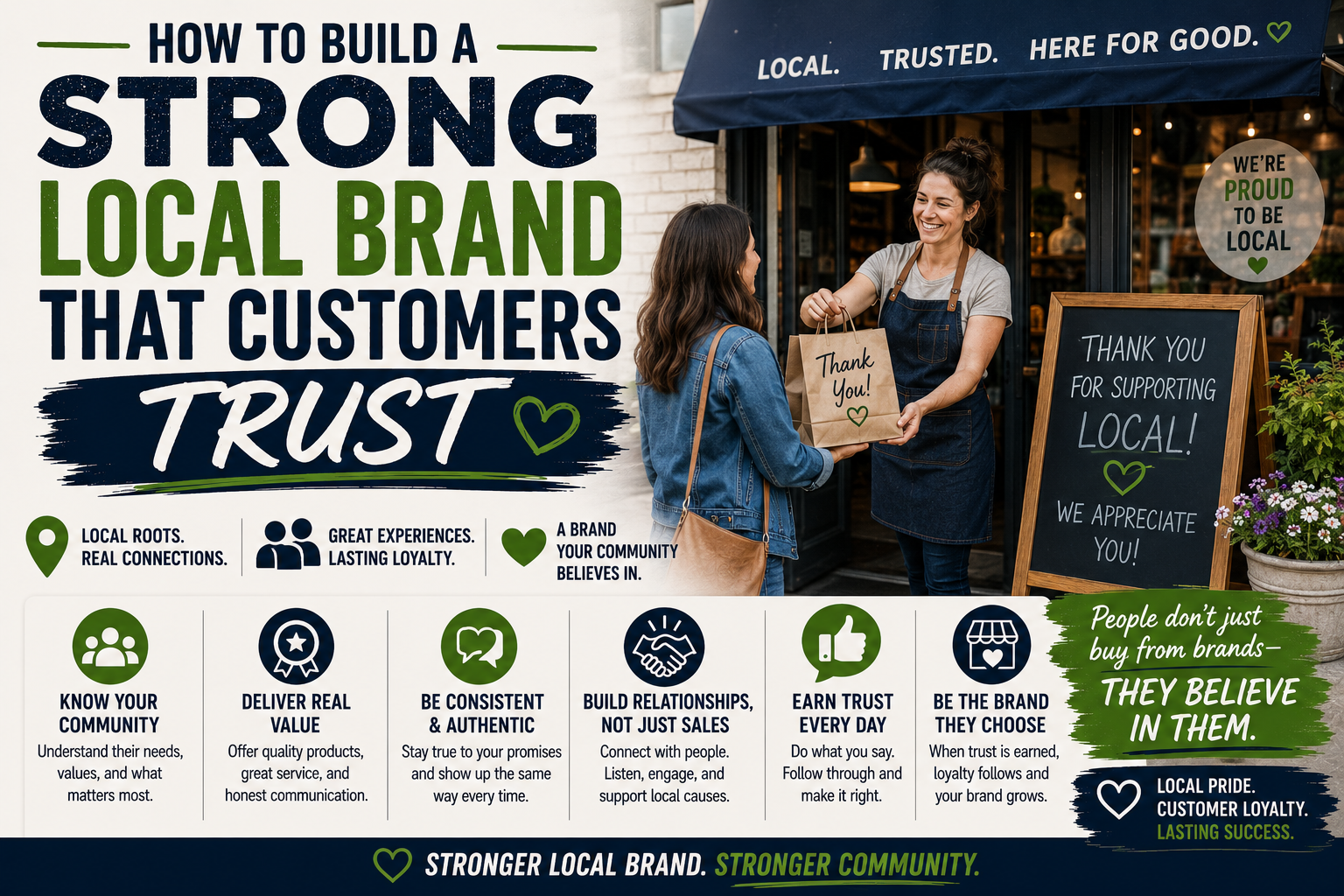
How to Build a Strong Local Brand That Customers Trust
Randall Magwood

Let me tell you something most business owners don’t want to hear…


People don’t buy from you because you’re “the best.”


They buy because they trust you.


And in a local market? Trust isn’t some fluffy, feel-good bonus. It’s the whole game. It’s the difference between being the go-to spot… or the place people drive past without a second thought.


So if you want a brand that actually pulls customers in—keeps them coming back—and gets talked about over dinner tables and group texts… here’s how you build it.


1. Stop Trying to Look Big. Start Acting Real.


A lot of local businesses fall into this trap: they try to look like a national brand.


Polished. Corporate. Safe.


Big mistake.


Because your biggest advantage isn’t scale—it’s proximity. You’re part of the community. You’re not some faceless operation three states away.


So lean into it.


  • Show your face.
  • Tell your story.
  • Let people see who’s behind the counter, the service truck, or the emails.


Customers trust people. Not logos.


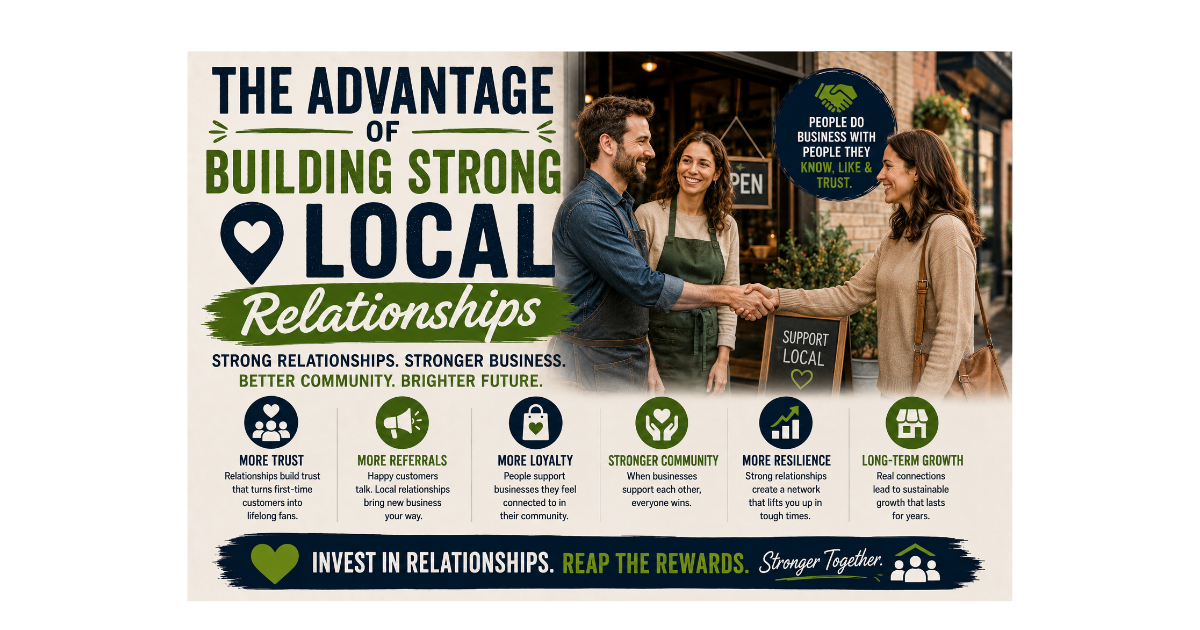
And when they feel like they know you? You’re no longer “a business.” You’re their place.


2. Be Known for One Thing (Even If You Do Ten)


If I asked someone what your business is known for, would they hesitate?


That hesitation is costing you money.


Strong local brands are crystal clear. They own a specific idea in the customer’s mind.


  • The fastest service
  • The friendliest staff
  • The cleanest shop
  • The most honest pricing


You can absolutely do more than one thing… but your brand needs a sharp edge.


Because confused customers don’t buy. Clear ones do.


So pick your lane. Hammer it home. Repeat it until people start saying it for you.


3. Make Every Interaction Feel Like a Recommendation


Here’s a simple test:


If someone walked into your business for the first time today… would they feel like they made a smart choice?


Or just another transaction?


Trust is built in moments:


  • The way you greet someone
  • How quickly you respond
  • Whether you explain things clearly—or hide behind jargon
  • If you follow through when you say you will


Most businesses are “fine” at this.


That’s why standing out isn’t that hard.


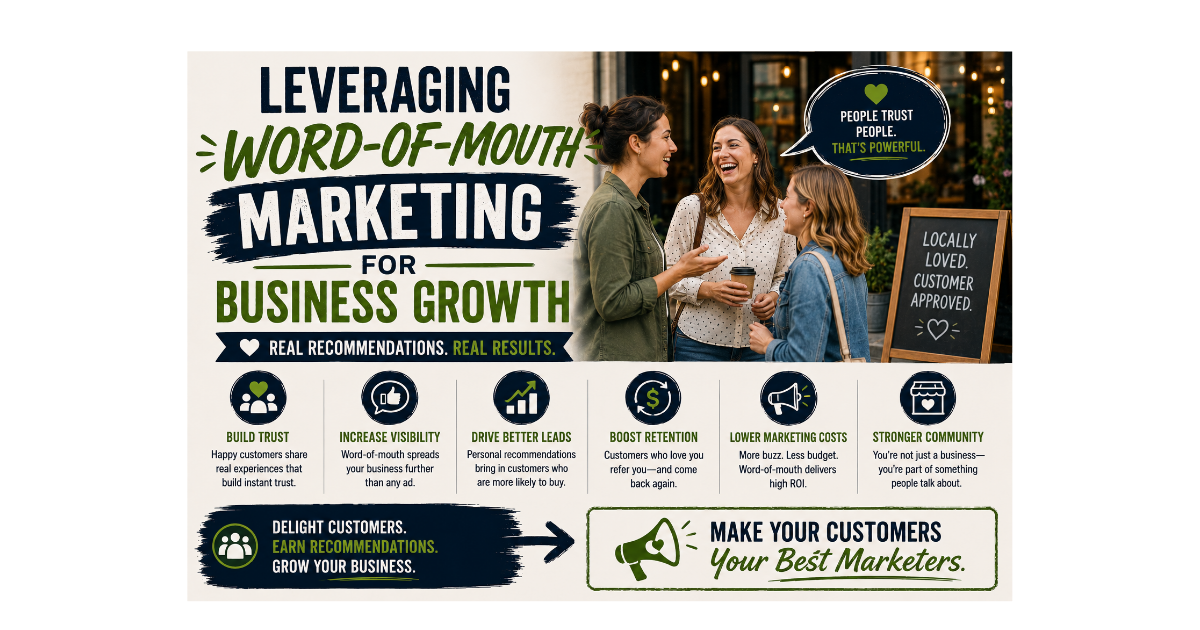
Do the small things exceptionally well, and people will start talking. And when word-of-mouth kicks in?


That’s when your brand starts to grow legs.


4. Consistency Beats Creativity (Every Time)


You don’t need to reinvent your brand every month.


You need to show up the same way—every time.


Same tone. Same quality. Same experience.


Because consistency creates familiarity.


And familiarity creates trust.


Think about it: the businesses people trust most are predictable in the best way. You know what you’re going to get. There’s no risk.


So instead of chasing clever campaigns or flashy ideas, ask yourself:


“Are we delivering the same great experience… every single time?”


If not, fix that first.


5. Turn Customers Into Proof


You can say you’re great all day long.


Nobody cares.


But when your customers say it? That’s gold.


So start collecting proof like your business depends on it—because it does.


  • Reviews
  • Testimonials
  • Before-and-after photos
  • Case studies
  • Social media shoutouts


And don’t just collect them… use them.


Put them everywhere:


  • Your website
  • Your storefront
  • Your emails
  • Your invoices


When a potential customer sees that others trust you, it lowers their guard instantly.


You’re no longer a gamble. You’re a safe bet.


6. Be Visible Where It Matters


You don’t need to be everywhere.


You just need to be where your local customers are already looking.


That might be:


  • Google searches
  • Local Facebook groups
  • Community events
  • Neighborhood newsletters
  • Partnerships with nearby businesses


The key is relevance.


Showing up consistently in the right places makes you feel familiar—even to people who’ve never bought from you.


And when they do need what you offer?


Guess who they think of first.


7. Own Your Reputation (Before It Owns You)


Here’s the reality: people are talking about your business whether you’re paying attention or not.


So you might as well take control of the conversation.


  • Respond to reviews (yes, even the bad ones)
  • Fix issues quickly—and publicly when appropriate
  • Thank people for positive feedback
  • Stay calm, professional, and human


A well-handled complaint can actually increase trust.


Why?


Because it shows you care. It shows you’re accountable. And it proves you’re not hiding when things go wrong.


That’s rare. And rarity builds reputation.


8. Give People a Reason to Come Back


Trust gets someone in the door.


But loyalty? That’s what builds a real brand.


So what’s your plan after the first sale?


  • Follow-up messages
  • Loyalty programs
  • Special offers for repeat customers
  • Personalized touches


Even something as simple as remembering a customer’s name—or their usual order—can create a connection most competitors never bother to build.


And once that connection is there?


Price matters less. Convenience matters less.


Because now they’re choosing you, not just what you sell.


9. Don’t Fake It. Customers Can Smell That


This might be the most important point of all.


You can’t manufacture trust with clever branding or slick marketing.


People see through it.


So don’t try to be something you’re not.


  • If you’re a small, family-run business—own it.
  • If you’re scrappy and fast—own it.
  • If you’re premium and detail-obsessed—own that too.


Authenticity isn’t a buzzword. It’s a shortcut.


Because when your brand matches your reality, everything becomes easier:


  • Your messaging feels natural
  • Your team knows how to act
  • Your customers know what to expect


No friction. No confusion. Just clarity.


10. Play the Long Game


Here’s the part nobody likes…


Building a trusted local brand takes time.


You don’t earn trust with one ad, one post, or one great experience.


You earn it by stacking those moments—day after day, week after week.


  • But here’s the upside:


Most of your competitors won’t do this.


They’ll chase quick wins. Shortcuts. Trends.


And while they’re bouncing around, you’ll be building something solid.


Something that compounds.


Something that turns first-time buyers into regulars… and regulars into advocates.


Final Thought


If you strip away all the tactics, tools, and trends… building a strong local brand comes down to this:


Do what you say you’re going to do… consistently… and let people see it.


That’s it.


No gimmicks. No magic tricks.


Just trust, earned the old-fashioned way.


And once you have it?


You won’t need to chase customers anymore.


They’ll come looking for you.
By Randall Magwood April 29, 2026
If your store feels more like a museum than a marketplace… you’ve got a problem. People stroll in. They browse. They nod politely. Then they walk out and say those four deadly words: “I’ll think about it.” Translation? You gave them zero reason to act right now. And in retail, “later” is just a polite way of saying “never.” Urgency is what turns browsers into buyers. It’s the invisible force that nudges someone off the fence and toward the register. So let’s fix that . Here are six proven, street-tested ways to inject urgency into your physical store—without coming off like a pushy, desperate salesperson. 1. Use Real Deadlines (Not Fake Ones) Nothing kills credibility faster than a “sale” that never ends. Customers aren’t stupid. They’ve seen the “Closing Sale” banner hanging in the same dusty window for six months. Urgency only works when it’s believable. So give your offers a clear, hard deadline—and stick to it. “Ends Sunday at 6 PM” “Today only” “This weekend—no extensions” Then follow through. When the deadline hits, the deal is gone. Why does this work ? Because people hate missing out more than they love getting a deal. It’s called loss aversion—and it’s powerful. When customers know the clock is ticking, hesitation feels expensive. 2. Limit Quantities (And Make It Visible) Scarcity creates urgency faster than anything else. If there are only 5 items left… that decision suddenly gets a lot easier. But here’s the key: don’t just say it— show it . Display low-stock items front and center Use signs like “Only 3 left in stock” Train staff to mention inventory naturally: “We’ve had a lot of interest in this—just a few left.” This taps into a primal instinct: if something is scarce, it must be valuable. And when people think they might lose access to something? They move. 3. Create In-Store-Only Offers If customers believe they can get the same deal later—or online—they’ll delay. So give them a reason to act while they’re standing in your store. Examples: “In-store exclusive pricing” “Available today only—not online” “Walk-in bonus: Free gift with purchase” This does two things: It rewards immediate action It removes the “I’ll just buy it later” escape hatch When the best deal is right in front of them, right now… waiting becomes irrational. 4. Use Time-Based Events Turn your store into something that happens, not just something that exists. Events create natural urgency because they’re tied to a moment in time. Think : Flash sales (2–4 hours max) Live demos with limited seating “Happy hour” discounts Product launches with bonuses for early buyers When something has a start and end time, it demands attention. People don’t want to miss out on an experience. And while they’re there? They buy. 5. Stack Bonuses Instead of Discounts Most store owners default to discounts. Big mistake. Discounts can cheapen your brand—and train customers to wait for the next sale. Instead, stack bonuses that disappear after a deadline. Example : “Buy today and get: Free setup Extended warranty Bonus accessory” Tomorrow? Those extras are gone. This creates urgency without slashing your margins. And psychologically, it feels like a bigger win. Customers love getting more—even more than they love paying less. 6. Train Your Staff to Reinforce Urgency (Without Being Annoying) Your signage can only do so much. Your staff is where urgency comes alive—or dies. But here’s the trick: it has to feel natural, not scripted. Instead of pressure, teach your team to inform. Bad: “You should buy this today.” Better : “Just so you know, this promo wraps up tonight.” Bad: “This is selling fast!” Better : “We’ve sold quite a few of these today—inventory’s getting tight.” See the difference? One feels pushy. The other feels helpful. When urgency is framed as useful information, customers lean in instead of pulling away. Final Thought: Urgency Isn’t Pressure—It’s Clarity A lot of store owners resist urgency because they don’t want to feel “salesy.” Fair enough. But here’s the truth : If you don’t give customers a reason to act now… you’re not being polite—you’re being unclear. People are busy. Distracted. Overloaded with choices. Urgency cuts through that noise. It answers the silent question in every shopper’s mind: “Why should I buy this today?” When you answer that clearly—and honestly—you don’t need to push. They’ll pull themselves to the register. And that’s when your store stops being a showroom… …and starts becoming a sales machine.
By Randall Magwood April 27, 2026
If your advertising feels like shouting into the void, it’s not because advertising is “dead.” It’s because you’re talking to everyone instead of someone. Hyperlocal marketing fixes that. It zooms in. Gets specific. Talks to real people in a real place with real problems—and makes your offer feel like it was built just for them. And when you do that right? You stop chasing customers… and start attracting buyers. Here are 10 hyperlocal strategies that don’t just sound good in theory—they actually pull in business. 1. Own the Neighborhood Conversation Most businesses try to go “big.” Smart businesses go small and dominant. Pick a tight geographic pocket—one neighborhood, a few zip codes, even a couple of streets—and become the name people hear over and over. This means : Sponsoring local newsletters Running ads in community Facebook groups Posting consistently on platforms like Nextdoor Showing up at local events You want people saying: “Man, I see these guys everywhere.” Familiarity breeds trust. Trust breeds sales. 2. Use “Local Proof” Like a Weapon Generic testimonials are weak. “Great service!” doesn’t move anyone. But this? “These guys fixed my roof in Dilworth after that last storm—fast and affordable.” That’s gold. Sprinkle your marketing with: Neighborhood names Local landmarks Recognizable situations Make prospects think: “They help people just like me… right here.” That’s when resistance melts. 3. Geo-Targeted Ads That Don’t Feel Like Ads Most local ads scream, “I’m an ad!” Big mistake . Instead, run geo-targeted campaigns that feel like helpful content. Examples: “5 Things Every South End Homeowner Should Check Before Summer” “Why Plaza Midwood Homes Are Losing Value (And How to Fix It)” These hook attention because they’re specific—and curiosity does the heavy lifting. Then you slide in your offer. No hard sell. Just relevance. 4. Partner With Local Businesses (Steal Their Audience) You don’t need more traffic. You need borrowed trust. Find businesses that already serve your ideal customer—but don’t compete with you. Then: Swap email promotions Bundle offers Cross-promote on social Leave materials at each other’s locations Example : A gym partners with a smoothie shop. A realtor partners with a moving company. You instantly tap into a warm audience that already trusts the source. 5. Dominate Local Search (Without Getting Technical) When people need something nearby, they search. If you’re not showing up, you don’t exist. But here’s the trick… You don’t need to “rank everywhere.” You just need to show up for: “near me” searches your service + neighborhood your service + city Focus on : Consistent business listings Reviews (lots of them) Location-based content on your site This isn’t sexy. But it prints money. 6. Direct Mail That Doesn’t Go Straight to the Trash Yes, direct mail still works. But only if it doesn’t look like junk. Most mail gets ignored because it’s bland. So don’t be bland. Use : Bold headlines Curiosity-driven hooks Local references A clear, irresistible offer And for the love of profit… Make it look like a personal letter, not a corporate brochure. That alone can double response. 7. Hyperlocal Offers That Feel Exclusive People love feeling like insiders. So stop running generic promotions. Instead, create offers tied to a specific area: “Uptown Residents Only: Free Consultation This Week” “Ballantyne Homeowners Get 20% Off—Ends Sunday” Now your offer feels: Scarce Targeted Special And that drives action. 8. Event-Based Marketing (Where Attention Is Already High) You don’t need to create attention. You just need to show up where it already exists. Local events are perfect for this: Farmers markets Festivals School events Community fundraisers But don’t just show up with a banner. Engage people. Give them : Something useful Something memorable Something worth talking about If you can make them smile, laugh, or think… You’ve already won half the battle. 9. Door-to-Door… Done Right This one scares people. Good. That’s why it works. Because almost no one is willing to do it. But here’s the key … Don’t “sell.” Start conversations. Use something like: “Hey, quick question—have you had any issues with [common local problem]?” “We’ve been helping a few homes on this street with [specific issue]…” Keep it natural. Keep it human. And always lead with value. When done right, this can outperform digital ads all day long. 10. Become the Local Authority (Not Just Another Option) If you’re just another business… You’re invisible. But if you’re the go-to expert ? Now you’re in control. Create content specifically for your area: Local guides Market insights Problem-solving videos Community updates Example : “The Hidden Costs of Living in [Neighborhood]” “What Most [City] Homeowners Don’t Know About [Problem]” When people see you educating instead of pitching… You earn trust before the sale. And trust is the ultimate conversion tool. Final Word Hyperlocal marketing isn’t complicated. But it does require one thing most businesses avoid: Specificity. You’ve got to: Know your audience Speak their language Show up where they are Prove you belong in their world Do that consistently… And you won’t just get more leads. You’ll get better leads . The kind that already trust you… already like you… and are just waiting for you to make the offer. That’s when marketing stops feeling like a grind… And starts feeling like control.
By Randall Magwood April 27, 2026
Here's what you need to know about your marketing: You don’t have a marketing problem. You have a clarity problem. And it’s costing you money every single day. Because right now, somewhere in your business, there’s marketing that is working… …but you don’t know what it is. Worse? There’s marketing that’s quietly bleeding you dry… …and you’re probably doubling down on it. That’s not bad luck. That’s not “just how business is.” That’s flying blind. The Dangerous Lie You’ve Been Sold You’ve been told marketing is about “getting your name out there.” Brand awareness. Visibility. Impressions. Engagement. All those fluffy words that sound important but don’t pay the bills. Here’s the truth: If it doesn’t lead to a sale (or clearly move someone toward one), it’s not marketing. It’s noise. And noise is expensive. Yet most business owners are drowning in it. They’re posting on social media. Running ads. Sending emails. Trying direct mail. Tweaking websites. And when you ask them the simple question— “What’s actually working?” You get a shrug… or a guess. That’s a problem. Why You’re Confused (And It’s Not Your Fault… Entirely) Let’s break down the real reasons you don’t know what’s working. 1. You’re Tracking the Wrong Stuff Likes. Clicks. Views. Shares. These are vanity metrics . They make you feel good. They look impressive in reports. But they don’t tell you what actually matters: Did it make you money? You can have a post with 10,000 likes that generates zero sales. And a boring email with no flair that quietly brings in $5,000 . Which one’s working? Exactly. 2. You Don’t Have a Clear Path to Purchase If your marketing is a tangled mess of platforms and touchpoints… …you’ll never know what’s pulling the weight. Someone sees a Facebook post. Then Googles you later. Then reads a blog. Then signs up for your email list. Then buys two weeks later. So what worked? The post? The blog? The email? You don’t know —because you didn’t design the journey. You just threw stuff out there and hoped it stuck. 3. You’re Not Using Unique Tracking This is where things get brutally simple—and brutally honest. If you’re running multiple campaigns and they all point to the same place… ...you’ve already lost the ability to measure. Different ads should have different links. Different mailers should have different phone numbers. Different offers should be… different. Otherwise, you’re guessing. And guessing is expensive. 4. You Change Things Too Fast Here’s a classic mistake: You launch a campaign. Three days go by. No fireworks. So you kill it and try something else. That’s not marketing—that’s impatience. Good marketing often needs time to breathe, optimize, and scale. But if you’re constantly pulling the plug… ...you’ll never gather enough data to know what works. 5. You’re Running Multiple Variables at Once You change the headline. And the offer. And the audience. And the platform. All at the same time. Then you wonder why you can’t figure out what made the difference. Here’s the rule : Test one variable at a time. That’s how pros do it. Everything else is chaos disguised as effort. The Real Cost of Not Knowing Let’s talk about what this confusion is actually costing you. Because it’s not just a minor inconvenience. It’s a silent profit killer . You scale losing campaigns You abandon winning ones too early You waste time chasing “new strategies” You burn out trying to keep up And worst of all… You start believing marketing “just doesn’t work for your business.” That’s nonsense. Marketing works. But only when you know what you’re doing—and more importantly, what’s working. How to Finally Get Clarity (Without Becoming a Data Nerd) You don’t need complicated dashboards. You don’t need a marketing degree. You just need discipline. Here’s how to fix this . Step 1: Define What “Working” Means Before you track anything, answer this: What is the goal? A phone call? A booked appointment? A sale? Pick one. Because if you don’t define success, everything looks like progress. Step 2: Use Simple Tracking Mechanisms You don’t need fancy tools to start. Unique URLs for each campaign Separate landing pages Call tracking numbers Coupon codes Now when a lead comes in… you know exactly where it came from. No guessing. Step 3: Create a Controlled Funnel Stop sending people everywhere. Give them one clear path: Ad → Landing Page → Offer → Action Now you can see where things break. And where they shine. Step 4: Test Like a Pro Change one thing at a time. Headline. Offer. Image. Audience. And track the result. Do this consistently, and something magical happens: Patterns emerge. And patterns lead to profit. Step 5: Let Winners Run When something works… don’t touch it . Don’t “improve” it. Don’t “freshen it up.” Milk it. Scale it. Exploit it like it owes you money. Because in a way—it does. The Mindset Shift That Changes Everything Here’s the shift most people never make: Stop thinking like a marketer. Start thinking like a detective . Your job isn’t to be creative for the sake of it. Your job is to uncover what works—and do more of it. Relentlessly. Without ego. Without distraction. Because the market doesn’t care how clever you are. It only responds to what resonates. Final Word Right now, your marketing is talking to you. It’s giving you signals. Clues. Data. But if you’re not set up to listen… ...you’ll miss all of it. And you’ll keep doing what most business owners do: Throw money at random tactics… Hope something sticks… And wonder why results are inconsistent. You can keep guessing. Or you can start knowing . Because once you know what marketing is working… Everything changes. Your confidence. Your decisions. Your revenue. And suddenly, marketing stops feeling like a gamble... ...and starts acting like a machine.
By Randall Magwood April 24, 2026
If you’re picturing a dusty stack of yesterday’s papers sitting untouched on a diner counter… you’re not wrong. But you’re not entirely right either. Because while the world has sprinted into digital— scrolling, swiping, skipping —there’s still a quiet, stubborn corner of the marketplace where ink on paper carries a different kind of weight. The question isn’t “Do newspaper ads still work?” The real question is: “Do they still work for you?” Let’s dig in . The Myth That Newspaper Advertising Is Dead People love declaring things dead. Email was “dead.” Direct mail was “dead.” Even websites were “dead” for a minute there. Funny thing is… all of them are still pulling in billions. Newspapers? Same story—just more selective. Yes, circulation has dropped. Yes, younger audiences aren’t grabbing the morning edition with their coffee. But here’s what most marketers miss: The people who are reading newspapers tend to have money… and fewer distractions. That’s not a small detail. It’s everything. Attention Is the Real Currency Online, your ad is one of a thousand. It’s competing with cat videos, breaking news alerts, and a cousin’s vacation photos—all in the same breath. In a newspaper? Your ad sits in a quieter room. No pop-ups. No autoplay videos. No algorithm shoving you aside. Just the reader… and the page. That kind of focused attention is rare in 2026. And rare usually means valuable. Who Still Responds to Newspaper Ads? Let’s get specific. Newspaper ads still pull their weight in markets where: The audience skews older (think 45+) The community is tight-knit or local Trust matters more than flash Buying decisions aren’t impulsive This includes : Local service businesses (roofers, plumbers, dentists) Financial services Legal professionals Health-related offers Real estate These audiences aren’t chasing trends. They’re looking for reliability. And oddly enough, a printed ad can feel more legitimate than a digital one. The Trust Factor No One Talks About Here’s something digital marketers don’t like admitting: People are more skeptical online than ever. Fake reviews. Scam ads. Deepfakes. AI-generated everything. Consumers are tired—and cautious. But when your ad shows up in a physical newspaper? It carries a subtle endorsement: “If it’s printed here… it must be somewhat legit.” Is that always true? Of course not. But perception drives response. And perception still favors print in certain markets. The Hidden Advantage: Less Competition Back in the day, newspapers were crowded with advertisers. Today? Not so much. Many businesses have abandoned print entirely, chasing cheaper clicks online. That leaves a gap. And gaps are where smart marketers make money. With fewer advertisers: Your ad stands out more You can negotiate better rates You’re not fighting for space against 50 competitors In some cases, you’re practically the only show in town. But Let’s Be Honest - It’s Not All Sunshine Newspaper ads aren’t magic. They come with real drawbacks. For starters: Tracking is harder. You can’t just click a dashboard and see conversions in real time. You have to get creative —unique phone numbers, custom URLs, specific offers. Then there’s cost. A decent-sized ad in a reputable paper isn’t cheap. And if your targeting is off? You’ll burn money fast. Plus, frequency matters. One ad won’t cut it. You need repetition to stick in the reader’s mind—and that adds up. What Makes a Newspaper Ad Work in 2026 If you’re going to test newspaper ads, don’t do it halfway. Most ads fail not because the medium is bad… but because the message is weak. Here’s what still works : 1. A strong, benefit-driven headline Not clever. Not cute. Clear. “Cut Your Energy Bill by 30% This Summer” beats “Innovative Home Solutions for Modern Living” every time. 2. Specificity Vague ads get ignored. Numbers, results, timeframes—these grab attention. 3. A compelling offer Discounts. Free consultations. Limited-time deals. Give people a reason to act now, not “someday.” 4. Proof Testimonials, case studies, before-and-after results. Even in print, credibility wins. 5. A clear call to action Tell them exactly what to do next. Call. Visit. Redeem. Scan. Don’t assume they’ll figure it out. The Hybrid Strategy That Smart Businesses Use Here’s where things get interesting. The best marketers aren’t choosing between print and digital. They’re combining them. A newspaper ad can: Drive traffic to a landing page Promote a local event Reinforce brand awareness already built online Think of it as a multiplier . Someone sees your ad in print… then later recognizes your business online. Now you’re familiar. And familiar businesses get chosen. So… Are Newspaper Ads Still Worth It? Here’s the straight answer: For the right business, in the right market, with the right message—yes. Absolutely. But if you’re expecting cheap leads, instant results, and perfect tracking? You’ll be disappointed. Newspaper ads require: Patience Consistency Strong copy And a willingness to test. The Bottom Line Most people dismiss newspaper ads because they feel outdated. But marketing isn’t about what feels modern. It’s about what works. And sometimes… the channels everyone ignores become the most profitable ones left. So instead of asking: “Is newspaper advertising dead?” Ask yourself: “Is my competition overlooking something that could give me an edge?” Because if they are… You might just find that yesterday’s medium is still making money today.
By Randall Magwood April 24, 2026
Most “marketing plans” are bloated, overcomplicated, and about as useful as a screen door on a submarine. You don’t need a 47-page document filled with charts, mission statements, and buzzwords nobody understands. What you need is a lean, mean, no-nonsense plan that actually brings customers through your door… and puts money in your pocket. So let’s strip this thing down to the studs and build something that works. Step 1: Get Brutally Clear on Who You Want If your marketing is aimed at “everyone,” it hits no one. You need to know exactly who you’re going after. Not vague fluff like “small business owners” or “homeowners.” I’m talking about specifics: Age range Income level Occupation Location Biggest frustrations What keeps them up at night For example: “Local homeowners, 35–60, who feel embarrassed about their outdated kitchen but don’t know where to start.” Now you’re cooking. Because when you know exactly who you’re talking to, your message starts hitting like a hammer instead of a feather. Step 2: Identify Their Pain (and Turn the Knife) People don’t buy because they’re interested. They buy because something is bothering them enough to take action. Your job is to find that problem… and shine a spotlight on it. Ask yourself: What are they sick of dealing with? What are they worried about? What have they already tried that didn’t work? Then call it out. Not gently. Not politely. Clearly. Example : “Tired of spending money on ads that don’t bring in real customers?” If they feel that in their gut, you’ve got their attention. Step 3: Craft an Offer That’s Hard to Refuse Here’s where most businesses fall flat on their face. They promote themselves. Nobody cares. People care about what they get. So instead of saying: “We offer professional landscaping services” You say : “Get a picture-perfect yard in 30 days… or we’ll keep working for free until you love it.” See the difference? Your offer should answer one question: “Why should I act right now?” Add urgency. Add a guarantee. Add a bonus. Make it feel like passing it up would be a mistake. Step 4: Choose 2–3 Offline Channels (Not 10) You don’t need to be everywhere. You need to be effective somewhere. Pick a few channels where your audience actually pays attention: Direct mail Flyers Door hangers Local newspapers Community bulletin boards In-store signage Referral cards Then commit. A mediocre message repeated consistently beats a brilliant message used once. Step 5: Create Simple, Punchy Marketing Pieces This is where the rubber meets the road. Your marketing materials don’t need to be pretty. They need to be persuasive. Focus on: A Strong Headline Grab attention immediately. “Stop Wasting Money on Marketing That Doesn’t Work” A Clear Problem Show them you understand. “Most local businesses burn cash on ads that never bring real customers.” Your Solution Position yourself as the fix. “We help you attract ready-to-buy customers using proven offline methods.” Your Offer Make it irresistible. “Try it risk-free for 30 days. If it doesn’t work, you don’t pay.” A Call to Action Tell them exactly what to do. “Call now,” “Visit today,” “Bring this card in” No fluff. No filler. No confusion. Step 6: Put a Tracking System in Place If you’re not tracking, you’re guessing. And guessing is expensive. You need to know what’s working and what’s not. Simple ways to track : Use different phone numbers for different campaigns Add a unique coupon code Ask every customer, “How did you hear about us?” This isn’t complicated. But it’s critical. Because once you know what’s working, you can double down and scale it. Step 7: Set a Budget You Can Stick To Here’s a mistake that kills momentum: Blowing your budget all at once… then disappearing. Consistency beats intensity. Instead of spending $5,000 in one burst, spread it out. Show up regularly. Stay visible. Become familiar. Because familiarity builds trust… and trust drives sales. Step 8: Build a Follow-Up System (Where the Money Is) Most businesses give up after the first contact. Big mistake. The real money is in the follow-up. Not everyone is ready to buy today. But that doesn’t mean they won’t buy later. Collect contact information whenever possible: Phone numbers Mailing addresses Emails Then follow up : Send postcards Mail special offers Check in with past customers You’re not being annoying. You’re staying top of mind. And when they’re ready… guess who they call? Step 9: Leverage Your Existing Customers This is the easiest money you’ll ever make. Happy customers are walking, talking billboards. Use that. Create a simple referral system: “Refer a friend and get $25 off your next service.” Or: “Bring a friend and you both get a bonus.” Give people a reason to spread the word. Because word-of-mouth, when done right, is rocket fuel. Step 10: Test, Tweak, Repeat Your first attempt doesn’t need to be perfect. It just needs to be live. Get it out there. Then improve it. Test different : Headlines Offers Formats Distribution areas Pay attention to results. Kill what doesn’t work. Scale what does. That’s how you build a marketing machine. Final Word You don’t need a complicated strategy. You need a simple plan… executed consistently. Know your audience. Hit their pain. Make a strong offer. Show up where they are. Track results. Follow up relentlessly. That’s it. Do this right, and you won’t just “have a marketing plan.” You’ll have a system that brings in customers… over and over again. And that’s the whole game.
By Randall Magwood April 23, 2026
Most business owners don’t have a marketing problem. They have a math problem… wrapped in wishful thinking… sprinkled with “I feel like it’s working.” That’s how money quietly disappears. You print 5,000 flyers. You sponsor a local event. You run a glossy print ad in that magazine everyone says they read… …and then you cross your fingers and hope the phone rings. Hope is not a strategy. And “awareness” doesn’t pay the bills. If you want to know whether your offline marketing is actually working—or just making you feel productive—you need to track ROI like a hawk. Let’s break it down the way a hard-nosed marketing consultant would: no fluff, no theory, just numbers that tell the truth. First: What ROI Actually Means (In Plain English) ROI stands for Return on Investment. Here’s the formula: ROI = (Revenue Generated – Cost of Campaign) ÷ Cost of Campaign That’s it. If you spent $1,000 and made $3,000: ROI = ($3,000 – $1,000) ÷ $1,000 = 2 That’s a 200% return . If you spent $1,000 and made $900? You didn’t “build awareness.” You lost $100. Step 1: Track Like Your Business Depends On It (Because It Does) Offline marketing has one big handicap: it’s easy to lose the trail. No clicks. No dashboards. No neat little graphs. So you have to force trackability into it. Here’s how: Unique phone numbers (call tracking) Dedicated landing pages (simple URLs) Coupon codes or offers (“Bring this flyer for 15% off”) Ask every customer: “How did you hear about us?” If you’re not doing at least one of these, stop everything. Because you can’t calculate ROI on guesswork. Step 2: Calculating ROI on Flyers Flyers are cheap. That’s why people abuse them. Let’s say you print and distribute 5,000 flyers. Your Costs: Design: $200 Printing: $300 Distribution: $500 Total Cost = $1,000 Your Results: 75 people respond 30 become customers Average sale: $80 Revenue = 30 × $80 = $2,400 ROI: ($2,400 – $1,000) ÷ $1,000 = 1.4 (140%) Not bad. But here’s where amateurs stop—and pros lean in. The Real Question: What’s the lifetime value of those customers? If each customer buys 3 times over the next year: 30 × $80 × 3 = $7,200 Now your ROI isn’t 140%. It’s 620% . Same flyer. Completely different story. Step 3: Calculating ROI on Events Events are trickier. They feel valuable. They look impressive. They can also quietly drain your wallet. Let’s say you sponsor a local event or host a booth. Your Costs: Booth fee: $800 Materials/signage: $400 Staff time: $600 Total Cost = $1,800 Your Results: 200 leads collected 40 convert into customers Average sale: $100 Revenue = $4,000 ROI: ($4,000 – $1,800) ÷ $1,800 = 1.22 (122%) Decent. But here’s the catch… Events Are Lead Generators—Not Always Sales Closers If you only count immediate sales, you’re underreporting ROI. What matters is: Email follow-ups Retargeting offers Repeat purchases If another 20 leads convert later? Now you’ve got: 60 customers × $100 = $6,000 New ROI: ($6,000 – $1,800) ÷ $1,800 = 2.33 (233%) That’s the difference between “meh” and “scale this immediately.” Step 4: Calculating ROI on Print Ads Print ads are where money goes to die… unless you know what you’re doing. Let’s say you run a magazine ad. Your Costs: Ad placement: $2,000 Design: $300 Total Cost = $2,300 Your Results: 50 inquiries 20 conversions Average sale: $150 Revenue = $3,000 ROI: ($3,000 – $2,300) ÷ $2,300 = 0.30 (30%) That’s weak. But don’t kill the ad just yet. Step 5: Diagnose Before You Cut A bad ROI doesn’t always mean a bad channel. It might mean: Weak headline Poor offer No clear call to action Wrong audience In other words… bad copy. Change the message, not the medium—first. Because when print works, it really works. Step 6: The Metrics That Actually Matter Forget vanity metrics like: “People saw it” “It looked great” “We got compliments” Here’s what matters: 1. Cost Per Lead (CPL) Total cost ÷ number of leads 2. Cost Per Acquisition (CPA) Total cost ÷ number of customers 3. Average Order Value (AOV) 4. Customer Lifetime Value (LTV) If your LTV is higher than your CPA… You’ve got a license to print money. Step 7: The Brutal Truth Most Won’t Tell You Most offline campaigns fail for one reason: No compelling offer. Not design. Not placement. Not timing. Offer . “Call us today” is not an offer. “Get 20% off your first visit” is better. “Get a free consultation + bonus gift (this week only)”? Now you’re talking. The stronger the offer, the higher the response. The higher the response, the better your ROI. Step 8: Compare Channels Like a Shark Once you have real numbers, you can do something powerful: Compare. Flyers: 140% ROI Events: 233% ROI Print ads: 30% ROI Where do you put your next dollar? Not where you like spending money. Where the numbers say to. Step 9: Scale What Works (Ruthlessly) If something is profitable, don’t “test more.” Scale it. Increase distribution Run the ad more frequently Attend more events But keep tracking. Because what works at small scale can break at big scale. Final Word: Stop Guessing. Start Knowing. Here’s the difference between struggling businesses and thriving ones: One group hopes their marketing works. The other group knows exactly what every dollar returns. Flyers, events, print ads—they’re not outdated. They’re just misunderstood. When tracked properly… optimized aggressively… and backed by a strong offer… They can outperform a lot of digital noise. So don’t ditch them. Master them. And the next time you spend $1,000 on marketing… You won’t be wondering what happened to it. You’ll be watching it come back—with friends.
By Randall Magwood April 23, 2026
Your direct mail piece isn’t competing with other marketers. It’s competing with pizza coupons, overdue bills, and that mysterious envelope labeled “IMPORTANT DOCUMENT ENCLOSED” (which is never important and never a document). So if your mail isn’t getting opened, it’s not because “direct mail is dead.” It’s because your mail looks like everything else people are trained to ignore. Here’s how to fix that . These 12 tips aren’t theory. They’re battle-tested, mailbox-proven, and built to get your envelope cracked open—and your message read. 1. Stop Looking Like Junk Mail If it screams “advertisement,” it’s dead on arrival. Use: Real stamps instead of metered postage Handwritten or handwritten-style fonts Plain envelopes Your goal? Blend in with personal mail. Because nobody throws away something that looks like it might be from a real person. 2. Use Curiosity Like a Crowbar Curiosity is the ultimate envelope opener. Tease something inside… but don’t give it away. Examples: “You’re going to want to see this before Friday.” “This might be the easiest decision you make all year.” Make them need to know what’s inside. 3. Make It About THEM (Not You) Nobody cares about your company. They care about their problems, their money, their time, their headaches. Bad: “We’ve been serving the community for 25 years…” Better : “If you’re tired of overpaying for [X], read this.” Talk to the reader like their situation matters—because it does. 4. Use a Lumpy Mail Trick People are curious creatures. If your envelope has something inside that creates a bump—coin, key, small object—it gets opened. Why? Because it breaks the pattern. And pattern interrupts get attention. 5. Write Like You Talk If your copy sounds like it came from a committee… it’s going in the trash. Write like a human. Short sentences. Simple words. No corporate fluff. Imagine you’re writing to one person. Because you are. 6. Give Them a Reason to Open NOW Urgency beats procrastination every time. Try : “Response needed by May 15” “Limited spots available” “Expires in 7 days” Without urgency, your mail gets put aside. And “put aside” is where marketing goes to die. 7. Personalization Isn’t Optional Anymore “Dear Homeowner” is a one-way ticket to the trash can. Use : First names Location references Specific situations Even better—call out something they’re experiencing. Make it feel like it was written just for them. 8. Use a Strong First Line Inside Getting the envelope opened is only half the battle. Your first line needs to grab them by the collar. Examples : “If you’re paying too much for [X], this will sting a little.” “I’m going to show you how to save $500 this month…” No warm-up. No fluff. Hit hard immediately. 9. Make Your Offer Stupid Easy to Understand Confused people don’t buy. Spell it out : What they get What it costs What they need to do next If they have to think too hard, they won’t act. 10. Add Proof (Or Don’t Bother) Claims are cheap. Proof sells. Use : Testimonials Case studies Numbers Example: “We helped 217 local homeowners reduce their energy bills by an average of 32%.” That’s believable. That’s persuasive. 11. Use a Clear, Single Call to Action Don’t overwhelm them with options. Pick ONE action: Call this number Visit this URL Bring this card in Make it obvious. Make it easy. And repeat it. 12. Test Like Your Business Depends On It (Because It Does) Here’s the truth most marketers ignore: Your first version will probably lose. That’s normal. Test : Headlines Offers Envelope styles Formats Small tweaks can double—or triple—your response rate. The Real Secret Nobody Talks About Most direct mail fails for one simple reason: It’s boring . Safe. Predictable. Forgettable. And boring doesn’t get opened. If you want results, you’ve got to take a stand. Be bold. Be specific. Be different. Because the mailbox is a battlefield… …and the only mail that survives is the mail that demands attention. Final Word Direct mail isn’t dead. It’s just misunderstood. When done right, it’s one of the most powerful, profitable marketing channels you’ve got. But “done right” doesn’t mean pretty design or clever slogans. It means : Getting opened Getting read Getting acted on Use these 12 tips, and you’ll be ahead of 90% of marketers still sending out expensive paper that never gets a second glance. And if your next campaign still doesn’t pull? Good. Now you’ve got something to test. Because the winners in this game aren’t the ones who guess right… They’re the ones who keep improving until they can’t lose.
By Randall Magwood April 17, 2026
If you’re a business owner trying to squeeze more cash out of your marketing, you’ve probably wrestled with this question: Should you focus on in-store promotions… or external ads? Translation : Do you sell harder to the people already in front of you… Or spend money dragging new people through the door? Most people get this wrong. Not a little wrong—expensively wrong. So let’s break it down the way a hard-nosed copywriter would. First, Understand the Real Game You're Playing This isn’t about “which is better” in some abstract, marketing-theory sense. It’s about where the fastest, easiest money is hiding in your business. Because one of these strategies: Requires less effort Converts faster Costs less And often delivers immediate profit While the other : Burns cash upfront Relies on hope and timing And usually takes longer to pay off If you can’t tell which is which yet… keep reading. In-Store Promotions: The Low-Hanging Fruit Nobody Picks Here’s the truth most businesses ignore: The easiest sale you’ll ever make is to someone already standing in your store. They’ve already: Found you Chosen you Walked in Mentally committed to spending money And what do most businesses do? Nothing . They let that customer: Buy one item Pay Walk out That’s like inviting someone over for dinner… and handing them a cracker. Why In-Store Promotions Work So Well Because they hit people at the exact moment they’re most likely to buy. This is called peak buying intent . A few examples: “Buy one, get one 50% off” at checkout Upsell displays near the register Limited-time bundles Staff suggesting add-ons These aren’t gimmicks. They’re profit multipliers . A simple in-store promotion can: Increase average order value by 20–50% Move slow inventory Create urgency on the spot And here’s the kicker: You don’t have to pay to get the customer there. They’re already in your orbit. The Hidden Advantage: Zero Acquisition Cost External ads cost money. Every click, impression, or lead chips away at your margins. But in-store promotions ? They operate on traffic you’ve already paid for—or got organically. That means: Higher profit per sale Faster return Less risk It’s like squeezing more juice out of the same orange. External Ads: The Necessary Evil Now don’t get it twisted. External ads aren’t useless. They’re just… expensive optimism. When you run ads, you’re betting on a chain of events : Someone sees your ad They care enough to click or visit They trust you They decide to buy That’s a lot of friction. And every step leaks people. Why External Ads Feel Attractive Because they promise growth. More eyeballs. More traffic. More customers. And sometimes, they deliver. But here’s the reality: External ads are a volume game. You need: Testing Budget Patience Data Without those, you’re just lighting money on fire and calling it “marketing.” The Real Cost Nobody Talks About Let’s say you spend $500 on ads. You might: Get 1,000 clicks 100 visitors 10 buyers That’s a 1% conversion rate. Now compare that to someone already in your store, where conversion rates can be 20%, 30%, even higher. See the difference? External ads are about getting attention . In-store promotions are about monetizing attention . The Fatal Mistake Most Businesses Make They chase new customers… while ignoring the ones they already have. It’s backwards. They’ll spend: Thousands on ads Hours tweaking campaigns Endless effort trying to “get seen” But they won’t: Train staff to upsell Create compelling in-store offers Optimize the buying experience That’s like pouring water into a bucket full of holes. So What Works Better? If you’re looking for a clean, simple answer: In-store promotions win—every time—when it comes to immediate profit. Why? Higher conversion rates Lower cost Faster results But that doesn’t mean external ads are useless. It just means they shouldn’t be your first move. The Smart Strategy: Fix the Bucket Before Filling It Here’s how a sharp operator approaches this: Step 1: Max Out In-Store Revenue Before spending a dollar on ads, ask: Are we upselling effectively? Do we have irresistible offers at checkout? Are we increasing average order value? Are we giving customers a reason to buy more right now? If the answer is no, fix that first . Because every extra dollar you squeeze from existing customers makes future advertising cheaper and more profitable. Step 2: Then Add External Ads Once your in-store system is tight, ads become powerful. Now when someone walks in: They spend more They buy more often They’re more valuable That means you can afford to spend more to acquire them. And suddenly, ads that used to lose money… start printing it. A Simple Example Let’s say: Before optimization: Average sale = $20 Ad cost per customer = $15 Profit = $5 Not great. Now you add in-store promotions: Average sale jumps to $35 Same ad cost. Now : Profit = $20 Same customer. Same ad. 4x the profit. That’s the power of doing this in the right order. The Bottom Line If you’re choosing between in-store promotions and external ads, here’s the straight truth: In-store promotions make you money faster External ads help you scale later One is about optimization . The other is about expansion . And if you try to expand before you optimize? You’ll grow your problems instead of your profits. Final Word Stop chasing more traffic like it’s the magic answer. Look at the people already walking through your door. They’re not just customers. They’re missed opportunities … unless you give them a reason to spend more. Fix that first . Then—and only then—turn on the ad machine. That’s how you stop guessing… And start getting paid.
By Randall Magwood April 17, 2026
Most small business marketing doesn’t fail because of bad luck, bad timing, or “the algorithm.” It fails because of avoidable mistakes. The kind that feel harmless. Logical, even. Until your phone stops ringing. Until your ads stop converting. Until you’re sitting there wondering why your competitor—who you know isn’t better than you—is eating your lunch. Let’s fix that. Here are 10 of the most common marketing mistakes small business owners make—and what to do instead. 1. Trying to Sell to “Everyone” This is the fastest way to become invisible. When your message is for everyone, it lands on no one . You end up with vague, watered-down marketing that sounds like every other business in your space. No edge. No hook. No reason to care. Fix it : ck a specific audience. Not “homeowners.” Not “small businesses.” Think narrower: First-time homeowners with fixer-uppers Restaurants doing under $1M in revenue Busy moms who hate cooking The tighter your target, the sharper your message—and the easier it is to sell. 2. Leading With Features Instead of Benefits Nobody wakes up excited about your “advanced system,” “premium materials,” or “state-of-the-art process.” They care about what it does for them. Features are facts. Benefits are what people buy. Fix it : Translate every feature into a real-world outcome. Instead of: “24-hour service turnaround” Say: “Get back to business tomorrow—without losing customers today.” Paint the result. Make it tangible. 3. Weak, Forgettable Headlines Your headline is your first impression. And in most cases, your only one. If it doesn’t stop someone in their tracks, the rest of your marketing doesn’t matter. Fix it : Write headlines that hit at least one of these: A strong benefit A specific result A curiosity gap A clear problem Example: “Finally Fix Your Leaky Roof Without Paying $10,000 or Waiting 6 Weeks” That’s not clever. It’s effective. 4. No Clear Offer A lot of small business marketing sounds like this: “We provide quality service at competitive prices. Call us today.” That’s not an offer. That’s background noise. Fix it : Give people a reason to act now. Examples: Free estimate with same-day quote 20% off first service Buy one, get one Risk-free trial Stack the odds in their favor. Reduce friction. Make it easy to say yes. 5. Ignoring Follow-Up Most sales don’t happen on the first contact. But most small businesses treat marketing like a one-shot deal. Someone doesn’t buy immediately? They’re gone. That’s money left on the table. Fix it : Build simple follow-up systems: Email sequences Text reminders Retargeting ads Stay in front of prospects. Remind them. Nudge them. The fortune isn’t just in the follow-up—it’s in the consistent follow-up. 6. Blending In With Competitors Take a look at your competitors’ websites or ads. Now look at yours. Be honest —could someone tell the difference? If not, you’ve got a positioning problem. Fix it : Find your “hook.” What makes you different? Faster? More specialized? More affordable? More premium? Then lean into it hard. Don’t try to be everything. Be something specific. 7. Relying on One Marketing Channel Putting all your eggs in one basket is risky. Whether it’s Facebook ads, SEO, referrals, or foot traffic—any single channel can dry up overnight. Algorithms change. Costs rise. Trends shift. Fix it : Diversify your marketing: Paid ads Organic content Email list Direct mail Partnerships You don’t need to master everything. But you do need more than one pipeline. 8. No Strong Call to Action You’d be surprised how many businesses forget to tell people what to do next. Or they say it so weakly, it gets ignored. “Contact us for more information” isn’t compelling. Fix it : Be direct. Be clear. Be specific. “Call now for your free quote” “Book your appointment today” “Download your free guide” Tell them exactly what to do—and why they should do it now. 9. Focusing on Short-Term Tactics Only Chasing quick wins isn’t the problem. Relying only on them is. If your entire marketing strategy is built on short bursts—discounts, promos, one-off ads—you’re stuck on a treadmill. Fix it : Balance short-term and long-term: Short-term: offers, ads, promotions Long-term: brand, list building, reputation Think of it like this: Short-term gets you sales today. Long-term makes tomorrow easier. You need both. 10. Not Tracking What Works If you don’t know where your leads and sales are coming from, you’re flying blind. And guess what? Blind businesses waste money. A lot of it. Fix it : Track your results: Ask every customer how they found you Use simple analytics tools Monitor ad performance You don’t need complicated dashboards. Just enough data to answer one question: “What’s making me money—and what’s not?” Then double down on what works. Cut what doesn’t. The Bottom Line Here’s the truth most people won’t tell you: Marketing isn’t about being clever. It’s about being clear, consistent, and compelling. Small business owners don’t usually fail because they’re lazy or incapable. They fail because they’re guessing. They’re copying competitors. They’re hoping something works instead of building a system that does work. Fix these 10 mistakes, and you’ll already be ahead of most businesses in your market. Not because you’re doing anything fancy… But because you’re finally doing the fundamentals right. And in marketing, that’s where the real money is.