

Offline Marketing: The Complete Guide for Small Businesses (2026)
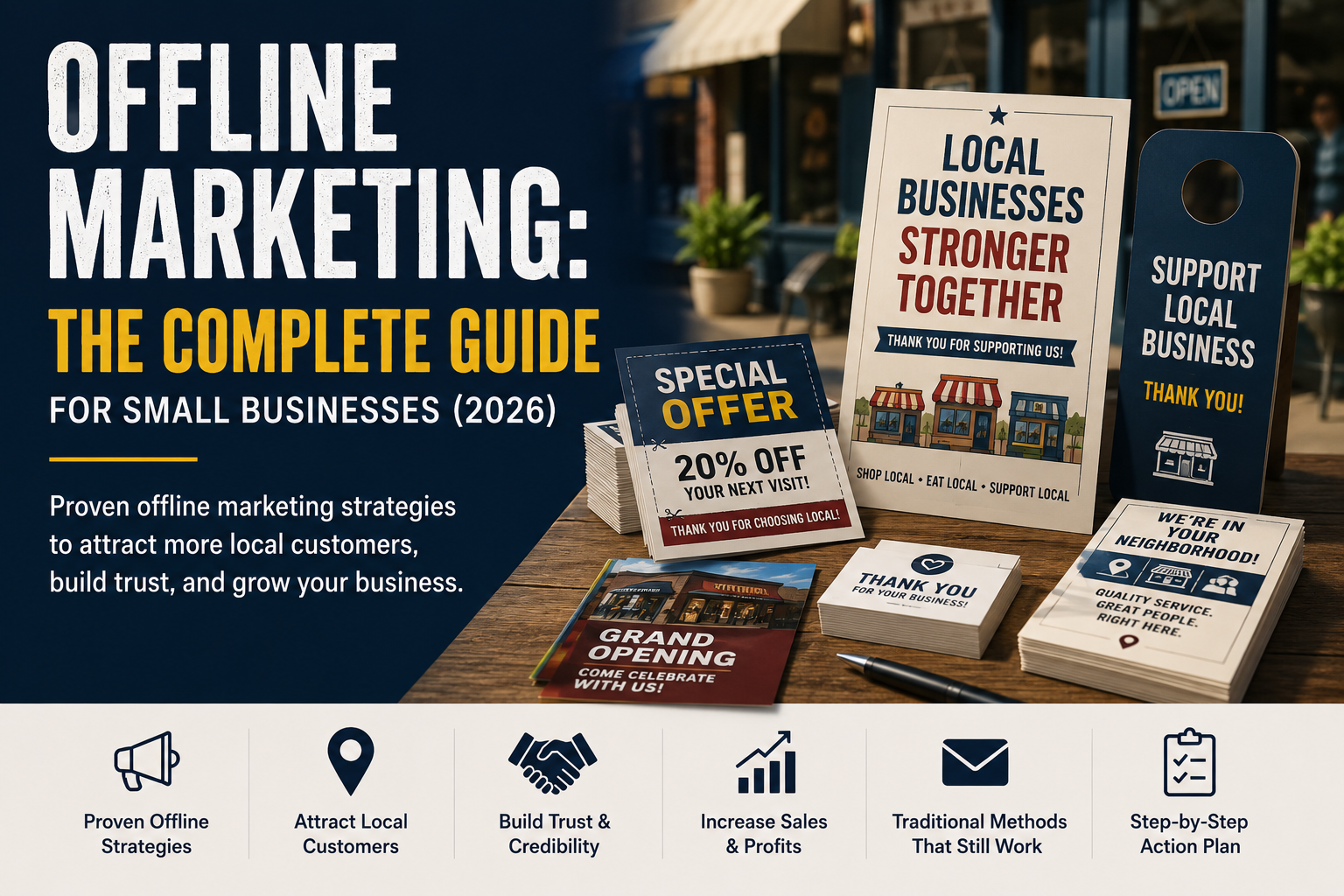
Discover proven offline marketing strategies that help local businesses attract customers, build trust, and grow profits - without relying on the internet.
1. What is Offline Marketing?
Offline marketing refers to any type of marketing that reaches customers outside of the internet.
Instead of relying on websites, social media, or online ads, offline marketing uses traditional methods such as flyers, direct mail, business cards, radio ads, billboards, signage, networking events, sponsorships, and word-of-mouth promotion.
These strategies help businesses build local visibility, increase trust, and connect with customers in the real world. Offline marketing is especially effective for small businesses that depend on local customers.
When combined with strong messaging and consistent branding, offline marketing can generate leads, drive foot traffic, and create long-term customer relationships that support steady business growth.
2. Why Offline Marketing Still Works in 2026
Many small businesses believe online is the only way to grow. But the truth is, offline marketing still drives massive results - especially for local businesses.
Offline marketing works because:
- It builds trust in your local community
- It reaches people where they already are
- It has less competition than digital channels
- It creates stronger brand recall
- It drives real-world action and in-person visits
3. Benefits of Offline Marketing

Builds Trust
People trust local businesses they see in their community.

Targets Local Customers
Reach the exact people most likely to buy from you.

Cost-Effective
Many offline strategies offer high ROI with small budgets.

Stronger Connections
Face-to-face and local touchpoints create loyal customers.
4. Types of Offline Marketing
List of Services
-
Print marketingList Item 1
Flyers, brochures, posters, business cards, and direct mail
-
Broadcast AdvertisingList Item 2
Radio and TV ads that build brand awareness locally.
-
Outdoor AdvertisingList Item 3
Billboards, signage, vehicle wraps, and transit ads.
-
Direct MailList Item 4
Postcards, letters, and catalogs delivered straight to homes.
-
Event Marketing
Sponsorships, local events, trade shows, and community involvement.
-
Referral Marketing
Encouraging happy customers to refer friends and family.
-
In-Person Networking
Building relationships through local networking and partnerships.
-
Promotional Products
Branded items that keep your business top of mind.


6. Offline Marketing Strategies That Actually Work
Some offline strategies have stood the test of time because they deliver real results.

Direct Mail Campaigns
Highly targeted and personalized mail gets high response rates.

Flyer & Door Hanger Marketing
Cost-effective and effective for local awareness.

Community Sponsorships
Builds trust and brand recognition in your local area.

Print Ads in Local Publications
Great for building credibility and visibility.
7. Measuring Offline Marketing ROI

You can't improve what you don't measure. Track these metrics:
- Response Rate: How many people responded to your campaign?
- Cost Per Lead/Customer: What did each lead or customer cost you?
- Sales Lift: Did you see an increase in sales during or after the campaign?
- Customer Lifetime Value: Are the customers you gained bringing long-term value?

9. Final Thoughts
Offline marketing is not old-fashioned, it's proven. When done right, it drives real people to take real action. The key is to have a plan, stay consistent, and keep testing.
Use the strategies in this guide to build visibility, attract more customers, and grow your business - one step at a time.
- Your customer is already in your community. Your job is to get in front of them in the right way!
Key Takeaways
- Offline marketing remains one of the most effective ways for small businesses to attract local customers, build trust, and generate long-term growth in 2026.
- Unlike digital advertising, offline marketing allows businesses to create tangible, memorable experiences that often leave a stronger impression on potential customers.
- Successful offline marketing strategies include direct mail, local advertising, print marketing, referral programs, community involvement, guerrilla marketing, signage, sponsorships, and promotional materials.
- The most effective campaigns focus on reaching a specific audience rather than trying to appeal to everyone.
- Consistency is one of the biggest drivers of marketing success. Businesses that maintain regular visibility in their communities often outperform competitors that advertise only occasionally.
- Word-of-mouth and referral marketing remain among the highest-converting customer acquisition channels because they are built on trust.
- Small businesses can often compete with larger companies by leveraging local relationships, community connections, and personalized customer experiences.
- Tracking campaign performance is essential. Marketing decisions should be based on measurable results rather than assumptions.
- Offline marketing works best when combined with online channels such as websites, email marketing, social media, and landing pages.
- A strong offer, compelling message, and clear call to action are often more important than the marketing medium itself.
- Marketing should be viewed as an ongoing investment rather than a one-time activity. Consistent effort compounds over time and creates lasting business growth.
- The ultimate goal of offline marketing is not simply to gain attention—it is to build awareness, generate leads, acquire customers, increase retention, and create a predictable stream of revenue.
- Businesses that master both customer acquisition and customer retention typically achieve the highest return on their marketing investment.
- The best offline marketing strategy is the one that consistently delivers profitable results, can be measured accurately, and can be scaled over time.
Frequently Asked Questions About Offline Marketing
What is offline marketing?
Offline marketing refers to any promotional activity that takes place outside of the internet. Common examples include direct mail, print advertising, billboards, signage, radio ads, community sponsorships, referral programs, networking events, and promotional products.
Is offline marketing still effective in 2026?
Yes. Offline marketing remains highly effective, especially for local businesses. Many offline channels face less competition than digital advertising and can help businesses build trust, increase visibility, and attract qualified customers.
What are the advantages of offline marketing?
Offline marketing can improve brand recognition, build credibility, create memorable customer experiences, and reach audiences that may not respond well to digital advertising. Physical marketing materials also provide a tangible connection to your brand.
What are some examples of offline marketing?
Examples include direct mail campaigns, flyers, brochures, newspaper ads, magazine ads, billboards, vehicle wraps, business cards, trade shows, local sponsorships, referral programs, community events, and promotional giveaways.
How does offline marketing differ from digital marketing?
Offline marketing uses traditional, non-internet channels to reach customers, while digital marketing relies on websites, search engines, social media, email, and online advertising. Many businesses achieve the best results by combining both approaches.
Is offline marketing expensive?
Not necessarily. Some methods, such as billboards and radio advertising, can be costly, but many offline marketing strategies are affordable. Referral programs, community partnerships, local networking, and targeted direct mail campaigns can often be implemented on modest budgets.
How can I measure the results of offline marketing?
You can track results using unique phone numbers, QR codes, coupon codes, landing pages, customer surveys, promotional offers, and point-of-sale tracking. Measuring performance helps identify which campaigns are generating the best return on investment.
Which offline marketing strategy works best for small businesses?
The best strategy depends on your industry, target audience, and goals. However, direct mail, referral marketing, local partnerships, community involvement, signage, and customer retention programs consistently perform well for many small businesses.
Can offline marketing help generate repeat customers?
Absolutely. Customer appreciation events, loyalty programs, referral incentives, direct mail follow-ups, and personalized communication can strengthen customer relationships and encourage repeat business.
Should small businesses use offline marketing and digital marketing together?
Yes. Offline marketing and digital marketing complement each other. Offline tactics can create awareness and trust, while digital channels help prospects learn more about your business, engage with your brand, and make purchasing decisions.
Discover proven offline marketing strategies local businesses can use to attract more customers and increase profits.
- Proven offline strategies
- Ideal for any local business
- Increase leads and sales