
How to Calculate ROI on Flyers, Events, and Print Ads (Without Fooling Yourself)
Most business owners don’t have a marketing problem.
They have a math problem… wrapped in wishful thinking… sprinkled with “I feel like it’s working.”
That’s how money quietly disappears.
You print 5,000 flyers. You sponsor a local event. You run a glossy print ad in that magazine everyone says they read…
…and then you cross your fingers and hope the phone rings.
Hope is not a strategy. And “awareness” doesn’t pay the bills.
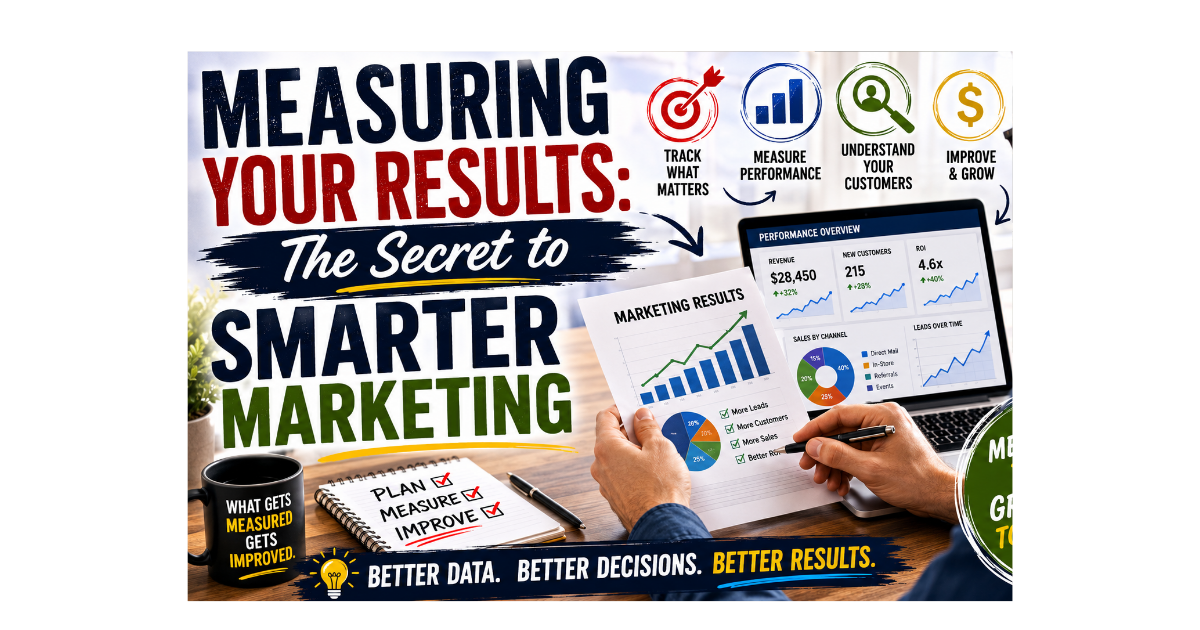
If you want to know whether your offline marketing is actually working—or just making you feel productive—you need to track ROI like a hawk.
Let’s break it down the way a hard-nosed marketing consultant would: no fluff, no theory, just numbers that tell the truth.
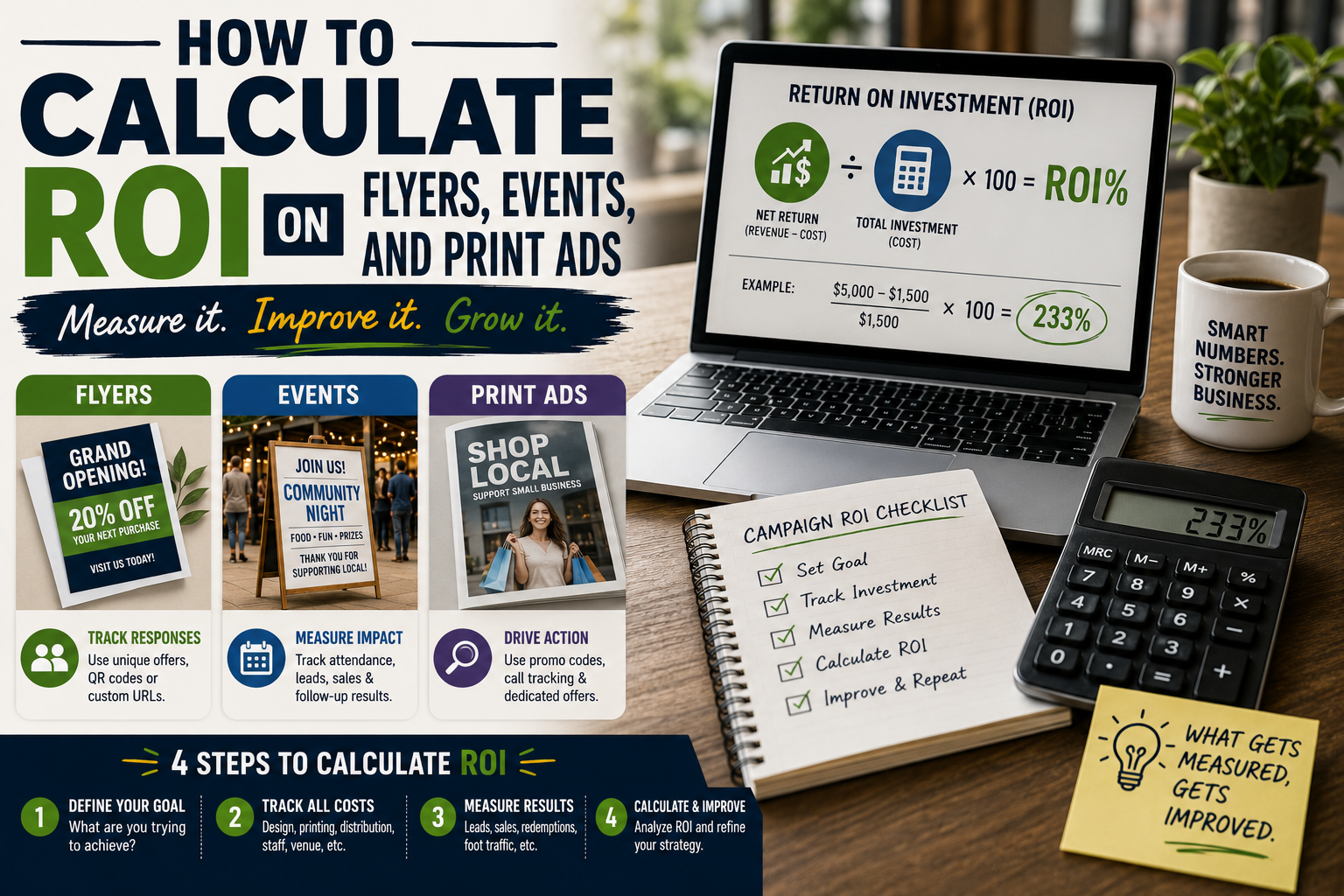
First: What ROI Actually Means (In Plain English)
ROI stands for Return on Investment.
Here’s the formula:
ROI = (Revenue Generated – Cost of Campaign) ÷ Cost of Campaign
That’s it.
If you spent $1,000 and made $3,000:
ROI = ($3,000 – $1,000) ÷ $1,000 = 2
That’s a 200% return.
If you spent $1,000 and made $900?
You didn’t “build awareness.”
You lost $100.
Step 1: Track Like Your Business Depends On It (Because It Does)
Offline marketing has one big handicap: it’s easy to lose the trail.
No clicks. No dashboards. No neat little graphs.
So you have to force trackability into it.
Here’s how:
- Unique phone numbers (call tracking)
- Dedicated landing pages (simple URLs)
- Coupon codes or offers (“Bring this flyer for 15% off”)
- Ask every customer: “How did you hear about us?”
If you’re not doing at least one of these, stop everything.
Because you can’t calculate ROI on guesswork.
Step 2: Calculating ROI on Flyers
Flyers are cheap. That’s why people abuse them.
Let’s say you print and distribute 5,000 flyers.
Your Costs:
- Design: $200
- Printing: $300
- Distribution: $500
Total Cost = $1,000
Your Results:
- 75 people respond
- 30 become customers
- Average sale: $80
Revenue = 30 × $80 = $2,400
ROI:
($2,400 – $1,000) ÷ $1,000 = 1.4 (140%)
Not bad.
But here’s where amateurs stop—and pros lean in.
The Real Question:
What’s the lifetime value of those customers?
If each customer buys 3 times over the next year:
30 × $80 × 3 = $7,200
Now your ROI isn’t 140%.
It’s 620%.
Same flyer. Completely different story.
Step 3: Calculating ROI on Events
Events are trickier. They feel valuable. They look impressive.
They can also quietly drain your wallet.
Let’s say you sponsor a local event or host a booth.
Your Costs:
- Booth fee: $800
- Materials/signage: $400
- Staff time: $600
Total Cost = $1,800
Your Results:
- 200 leads collected
- 40 convert into customers
- Average sale: $100
Revenue = $4,000
ROI:
($4,000 – $1,800) ÷ $1,800 = 1.22 (122%)
Decent.
But here’s the catch…
- Events Are Lead Generators—Not Always Sales Closers
If you only count immediate sales, you’re underreporting ROI.
What matters is:
- Email follow-ups
- Retargeting offers
- Repeat purchases
If another 20 leads convert later?
Now you’ve got:
60 customers × $100 = $6,000
New ROI:
($6,000 – $1,800) ÷ $1,800 =
2.33 (233%)
That’s the difference between “meh” and “scale this immediately.”
Step 4: Calculating ROI on Print Ads
Print ads are where money goes to die… unless you know what you’re doing.
Let’s say you run a magazine ad.
Your Costs:
- Ad placement: $2,000
- Design: $300
Total Cost = $2,300
Your Results:
- 50 inquiries
- 20 conversions
- Average sale: $150
Revenue = $3,000
ROI:
($3,000 – $2,300) ÷ $2,300 = 0.30 (30%)
That’s weak.
But don’t kill the ad just yet.
Step 5: Diagnose Before You Cut
A bad ROI doesn’t always mean a bad channel.
It might mean:
- Weak headline
- Poor offer
- No clear call to action
- Wrong audience
In other words… bad copy.
Change the message, not the medium—first.
Because when print works, it really works.
Step 6: The Metrics That Actually Matter
Forget vanity metrics like:
- “People saw it”
- “It looked great”
- “We got compliments”
Here’s what matters:
1. Cost Per Lead (CPL)
Total cost ÷ number of leads
2. Cost Per Acquisition (CPA)
Total cost ÷ number of customers
3. Average Order Value (AOV)
4. Customer Lifetime Value (LTV)
If your LTV is higher than your CPA…
You’ve got a license to print money.
Step 7: The Brutal Truth Most Won’t Tell You
Most offline campaigns fail for one reason:
No compelling offer.
Not design. Not placement. Not timing.
Offer.
“Call us today” is not an offer.
- “Get 20% off your first visit” is better.
- “Get a free consultation + bonus gift (this week only)”?
Now you’re talking.
The stronger the offer, the higher the response.
The higher the response, the better your ROI.
Step 8: Compare Channels Like a Shark
Once you have real numbers, you can do something powerful:
Compare.
- Flyers: 140% ROI
- Events: 233% ROI
- Print ads: 30% ROI
Where do you put your next dollar?
Not where you like spending money.
Where the numbers say to.
Step 9: Scale What Works (Ruthlessly)
If something is profitable, don’t “test more.”
Scale it.
- Increase distribution
- Run the ad more frequently
- Attend more events
But keep tracking.
Because what works at small scale can break at big scale.
Final Word: Stop Guessing. Start Knowing.
Here’s the difference between struggling businesses and thriving ones:
One group hopes their marketing works.
The other group knows exactly what every dollar returns.
Flyers, events, print ads—they’re not outdated.
They’re just misunderstood.
When tracked properly… optimized aggressively… and backed by a strong offer…
They can outperform a lot of digital noise.
So don’t ditch them.
Master them.
And the next time you spend $1,000 on marketing…
You won’t be wondering what happened to it.
You’ll be watching it come back—with friends.