
Why Customers Ask for Prices But Don’t Buy
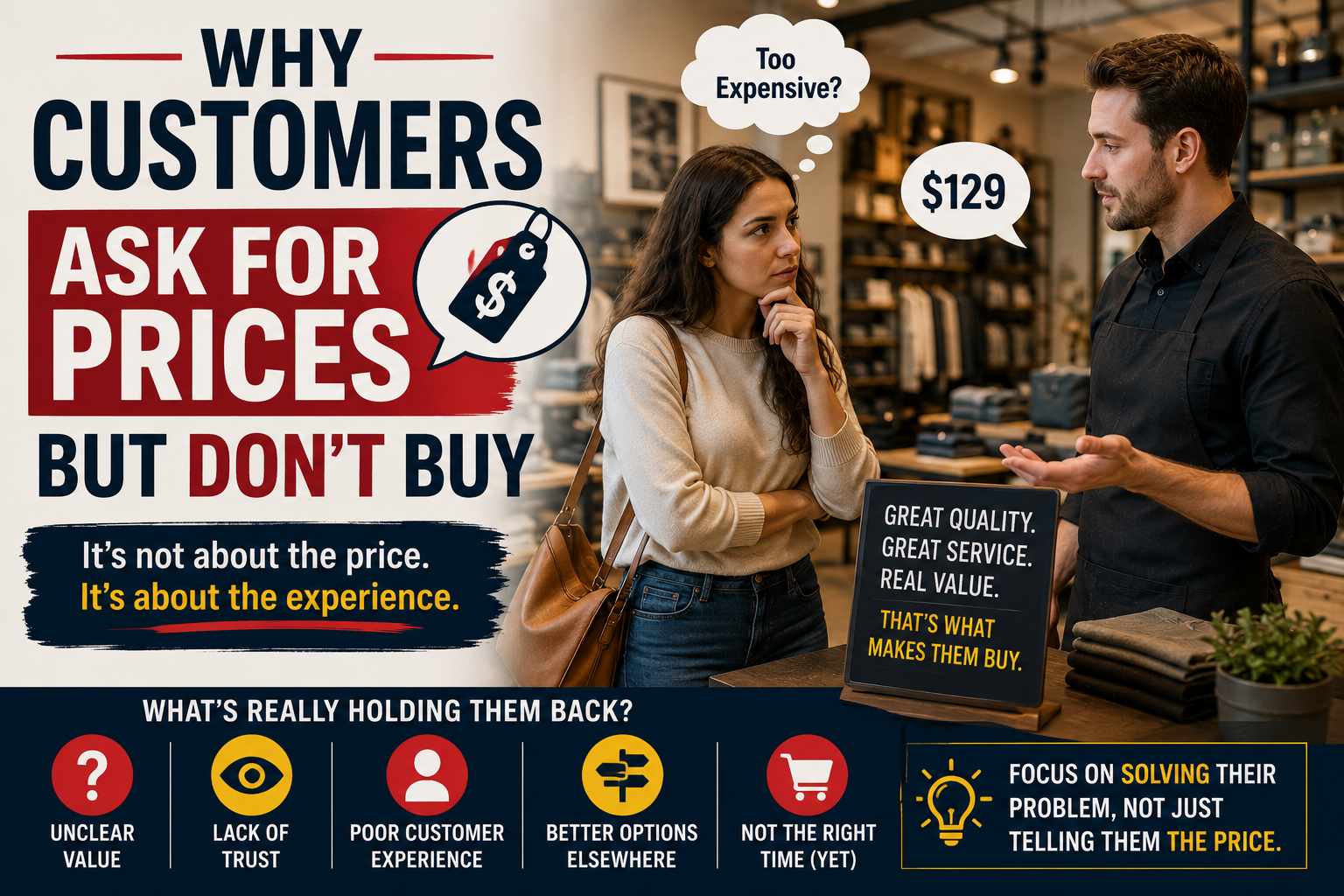
When a prospect asks for your price, it does not mean they’re ready to buy.
In fact, more often than not, it means the exact opposite.
They’re hesitating. They’re uncertain. They’re looking for a reason to say no… or at least a safe way to stall you while they figure out how to escape the conversation without feeling awkward.
Brutal? Maybe.
True? Absolutely.
If you’ve ever felt that little rush of excitement when someone asks, “So… how much is it?”—only to watch them vanish right after you answer—you’ve already learned this lesson the hard way.
So what’s really going on here?
Let’s peel it back.
Price Questions Are Often a Smoke Screen
Most prospects don’t ask about price because they’re ready to buy.
They ask because it’s the easiest, least confrontational question they can think of.
It feels safe.
Think about it from their perspective…
- They don’t fully understand what you’re offering.
- They’re not convinced it’s right for them.
- They’re unsure if they trust you yet.
But instead of saying all that out loud (which feels uncomfortable), they default to the one question that sounds logical:
“How much does it cost?”
It gives them control.
And it buys them time.
The Real Question They’re Asking (But Not Saying)
When someone asks for your price, what they’re really asking is:
- “Is this worth it?”
- “Can I justify this?”
- “Am I going to regret this decision?”
- “Why should I choose you over everyone else?”
Price is just the surface.
Underneath it is doubt.
And doubt kills sales faster than anything.
Why You Lose Them After You Give the Price
Here’s the moment where most business owners shoot themselves in the foot.
They hear the price question… and they answer it immediately.
- No context.
- No framing.
- No buildup.
Just a number.
And what happens?
The prospect grabs that number and compares it to… nothing.
- No perceived value.
- No emotional connection.
- No clear outcome.
So the price floats there, naked and exposed, begging to be judged.
And judged it is.
Usually harshly.
Because in the absence of value, every price feels too high.
Price Without Value Equals Resistance
Let me say that again, because it’s the core of the problem:
Price without value equals resistance.
- If the prospect doesn’t fully understand what they’re getting…
- If they can’t see the transformation…
- If they don’t feel the urgency…
Then your price becomes a barrier instead of a bridge.
And barriers don’t get crossed.
The “Shopping Mode” Trap
Another reason people ask for prices but don’t buy?
They’re not actually looking to buy.
They’re in what I call “shopping mode.”
You’ve seen it before.
- They’re gathering quotes.
- Comparing options.
- Kicking tires.
They’ll talk to five, ten, maybe even twenty businesses just like yours.
Not because they’re serious…
But because they think that’s what smart buyers do.
And in this mode, price becomes the main filter.
- Not quality.
- Not results.
- Not trust.
Just price.
If you let yourself get pulled into this game, you’ve already lost.
Because there will always be someone cheaper.
Always.
The Trust Gap Nobody Talks About
Here’s something most people miss:
When a prospect asks for your price too early, it often means you haven’t earned their trust yet.
- They don’t know you.
- They don’t believe you (yet).
- They’re not sure you can deliver.
So they fall back on price as a way to evaluate you.
It’s flawed logic, but it’s human nature.
And until you close that trust gap, the price will always feel like a risk.
How to Flip the Script (Without Being Pushy)
So what do you do when someone asks for your price?
You don’t dodge it.
But you don’t answer it right away either.
Instead, you take control of the conversation.
Here’s how.
1. Slow It Down
When they ask, “How much is it?”—resist the urge to blurt out a number.
Instead, say something like:
“Happy to go over pricing… but first, let me make sure this is actually a fit for you.”
This does two things:
- It positions you as a professional, not a commodity
- It shifts the focus from price to relevance
Now you’re leading the conversation instead of reacting to it.
2. Build Value Before You Name a Price
Before you ever say a number, you need to paint a picture.
- What problem are you solving?
- What result are you delivering?
- What happens if they don’t fix this?
Make it real. Make it specific. Make it matter.
Because once the prospect sees the value clearly, the price stops being the main issue.
3. Tie the Price to an Outcome
Never present your price in isolation.
Attach it to something meaningful.
Instead of:
“It’s $1,500.”
Say:
“It’s $1,500 to fix [specific problem] and get you to [specific result].”
- Now the price has context.
- Now it has purpose.
- Now it’s easier to justify.
4. Qualify Them (Yes, Really)
Not every prospect deserves your time.
If someone is laser-focused on price and nothing else, you have to ask:
Are they even a good fit?
Sometimes the best move is to let them go.
Because chasing low-commitment buyers drains your energy and kills your margins.
And worse…
It keeps you from focusing on the people who actually want what you offer.
5. Make It Safe to Say Yes
At the end of the day, most buying decisions come down to one thing:
Risk.
If the prospect feels like they might lose—money, time, reputation—they hesitate.
So your job is to reduce that risk.
- Clear expectations.
- Proof of results.
- Strong guarantees (when appropriate).
The safer it feels, the less price matters.
The Hard Truth Most People Avoid
Here it is, plain and simple:
People don’t walk away because of your price.
- They walk away because they don’t believe the value is there.
- Or they don’t trust that you can deliver it.
- Or they don’t feel enough urgency to act.
Price just gets the blame.
Final Thought: Stop Answering the Wrong Question
When a prospect asks, “How much is it?”—they’re not really asking about the price.
They’re asking whether this is worth it.
Whether they can trust you.
Whether this will actually work.
If you answer with just a number, you’ve missed the question entirely.
But if you answer the real concern underneath…
That’s when the conversation changes.
That’s when resistance drops.
That’s when people stop “shopping”…
And start buying.