
10 Common Marketing Mistakes Small Business Owners Make (And How They Quietly Kill Your Sales)
Randall Magwood

Most small business marketing doesn’t fail because of bad luck, bad timing, or “the algorithm.”


It fails because of avoidable mistakes. The kind that feel harmless. Logical, even.


  • Until your phone stops ringing.
  • Until your ads stop converting.
  • Until you’re sitting there wondering why your competitor—who you know isn’t better than you—is eating your lunch.


Let’s fix that.


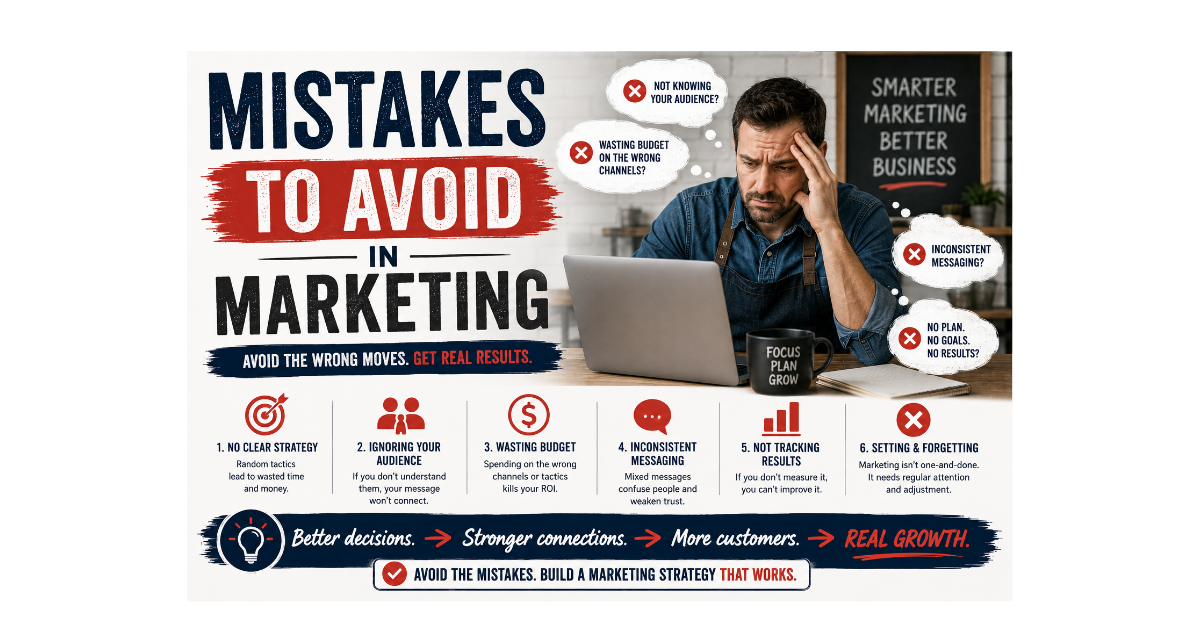
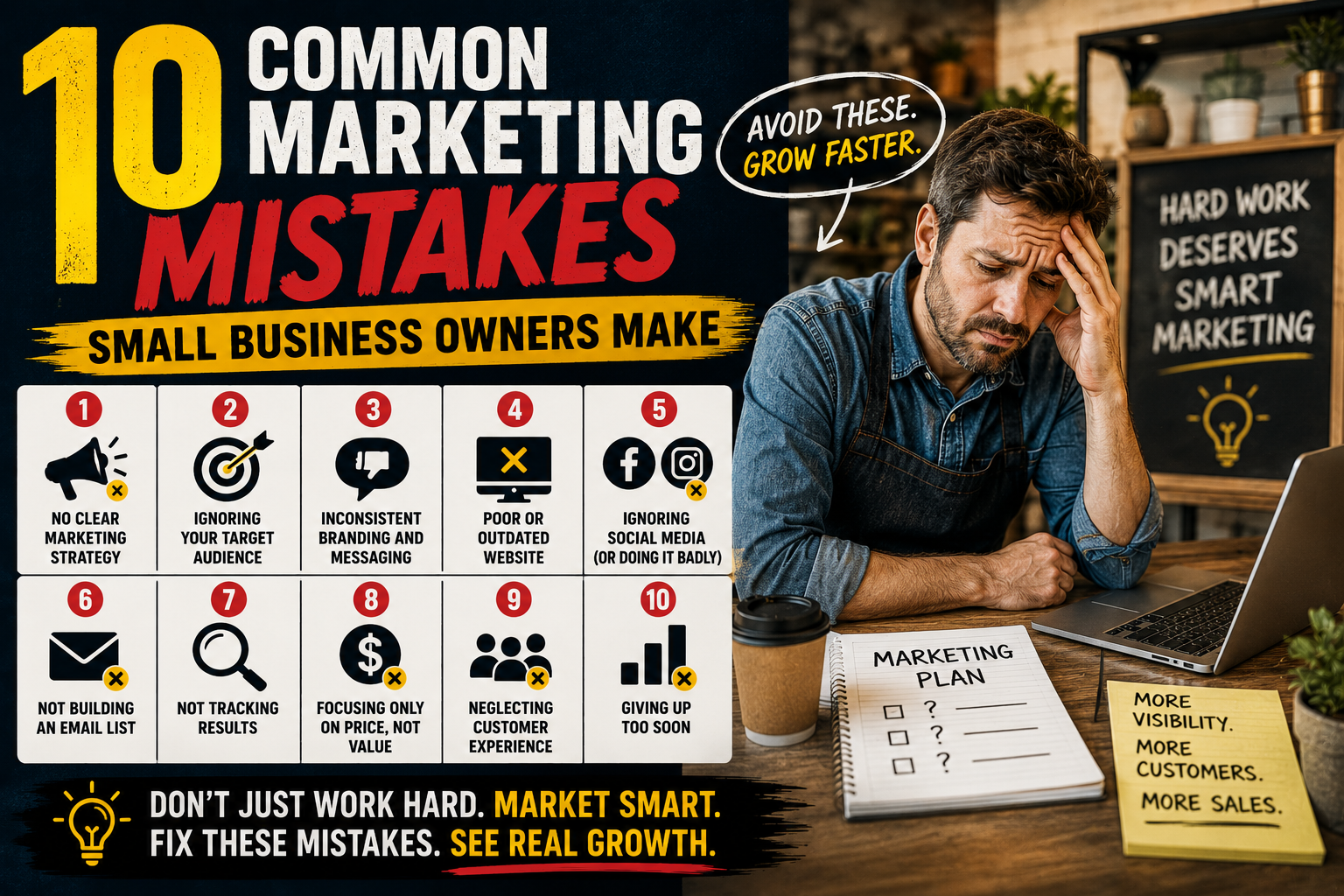
Here are 10 of the most common marketing mistakes small business owners make—and what to do instead.


1. Trying to Sell to “Everyone”


This is the fastest way to become invisible.


When your message is for everyone, it lands on no one.


You end up with vague, watered-down marketing that sounds like every other business in your space.


No edge. No hook. No reason to care.


Fix it:


ck a specific audience. Not “homeowners.” Not “small businesses.”


Think narrower:


  • First-time homeowners with fixer-uppers
  • Restaurants doing under $1M in revenue
  • Busy moms who hate cooking


The tighter your target, the sharper your message—and the easier it is to sell.


2. Leading With Features Instead of Benefits


Nobody wakes up excited about your “advanced system,” “premium materials,” or “state-of-the-art process.”


They care about what it does for them.


Features are facts. Benefits are what people buy.


Fix it:


Translate every feature into a real-world outcome.


Instead of:


“24-hour service turnaround”


Say:


“Get back to business tomorrow—without losing customers today.”


Paint the result. Make it tangible.


3. Weak, Forgettable Headlines


Your headline is your first impression.


And in most cases, your only one.


If it doesn’t stop someone in their tracks, the rest of your marketing doesn’t matter.


Fix it:


Write headlines that hit at least one of these:


  • A strong benefit
  • A specific result
  • A curiosity gap
  • A clear problem


Example:


“Finally Fix Your Leaky Roof Without Paying $10,000 or Waiting 6 Weeks”


That’s not clever. It’s effective.


4. No Clear Offer


A lot of small business marketing sounds like this:


“We provide quality service at competitive prices. Call us today.”


That’s not an offer. That’s background noise.


Fix it:


Give people a reason to act now.


Examples:


  • Free estimate with same-day quote
  • 20% off first service
  • Buy one, get one
  • Risk-free trial


Stack the odds in their favor. Reduce friction. Make it easy to say yes.


5. Ignoring Follow-Up


Most sales don’t happen on the first contact.


But most small businesses treat marketing like a one-shot deal.


Someone doesn’t buy immediately? They’re gone.


That’s money left on the table.


Fix it:


Build simple follow-up systems:


  • Email sequences
  • Text reminders
  • Retargeting ads


Stay in front of prospects. Remind them. Nudge them.


The fortune isn’t just in the follow-up—it’s in the consistent follow-up.


6. Blending In With Competitors


Take a look at your competitors’ websites or ads.


Now look at yours.


Be honest—could someone tell the difference?


If not, you’ve got a positioning problem.


Fix it:


Find your “hook.”


What makes you different?


  • Faster?
  • More specialized?
  • More affordable?
  • More premium?


Then lean into it hard.


Don’t try to be everything. Be something specific.


7. Relying on One Marketing Channel


Putting all your eggs in one basket is risky.


Whether it’s Facebook ads, SEO, referrals, or foot traffic—any single channel can dry up overnight.


Algorithms change. Costs rise. Trends shift.


Fix it:


Diversify your marketing:


  • Paid ads
  • Organic content
  • Email list
  • Direct mail
  • Partnerships


You don’t need to master everything. But you do need more than one pipeline.


8. No Strong Call to Action


You’d be surprised how many businesses forget to tell people what to do next.


Or they say it so weakly, it gets ignored.


“Contact us for more information” isn’t compelling.


Fix it:


Be direct. Be clear. Be specific.


  • “Call now for your free quote”
  • “Book your appointment today”
  • “Download your free guide”


Tell them exactly what to do—and why they should do it now.


9. Focusing on Short-Term Tactics Only


Chasing quick wins isn’t the problem.


Relying only on them is.


If your entire marketing strategy is built on short bursts—discounts, promos, one-off ads—you’re stuck on a treadmill.


Fix it:


Balance short-term and long-term:


  • Short-term: offers, ads, promotions
  • Long-term: brand, list building, reputation


Think of it like this:


  • Short-term gets you sales today.
  • Long-term makes tomorrow easier.


You need both.


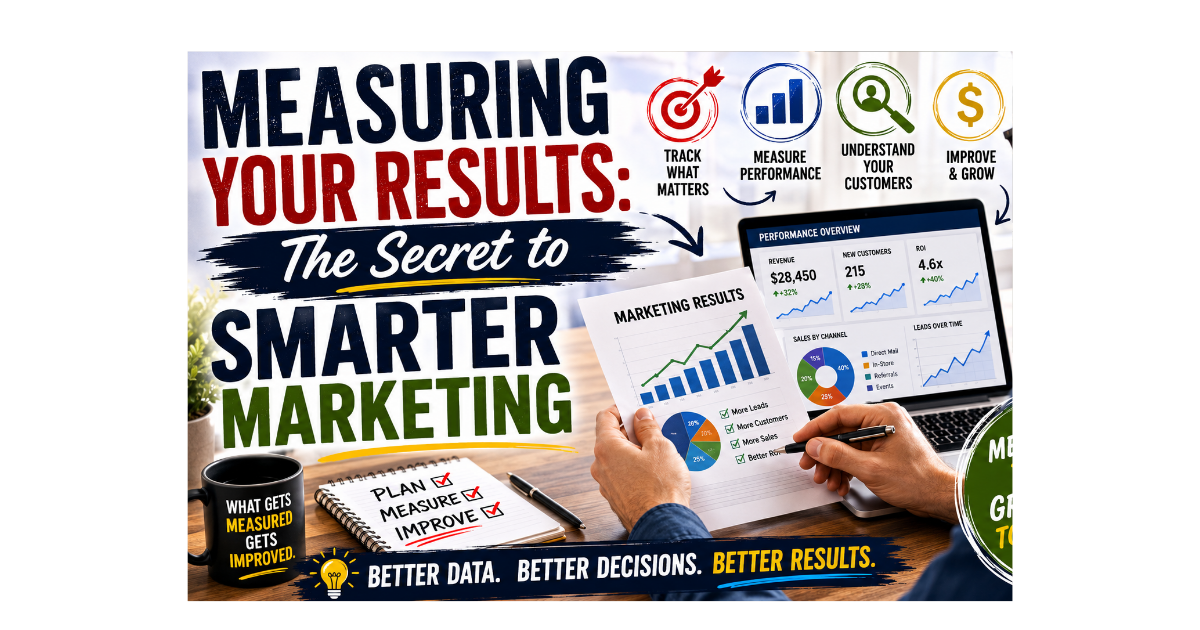
10. Not Tracking What Works


If you don’t know where your leads and sales are coming from, you’re flying blind.


And guess what? Blind businesses waste money.


A lot of it.


Fix it:


Track your results:


  • Ask every customer how they found you
  • Use simple analytics tools
  • Monitor ad performance


You don’t need complicated dashboards.


Just enough data to answer one question:


“What’s making me money—and what’s not?”


Then double down on what works. Cut what doesn’t.


The Bottom Line


Here’s the truth most people won’t tell you:


Marketing isn’t about being clever.


It’s about being clear, consistent, and compelling.


Small business owners don’t usually fail because they’re lazy or incapable.


  • They fail because they’re guessing.
  • They’re copying competitors.
  • They’re hoping something works instead of building a system that does work.


Fix these 10 mistakes, and you’ll already be ahead of most businesses in your market.


Not because you’re doing anything fancy…


But because you’re finally doing the fundamentals right.


And in marketing, that’s where the real money is.
By Randall Magwood April 17, 2026
If you’re a business owner trying to squeeze more cash out of your marketing, you’ve probably wrestled with this question: Should you focus on in-store promotions… or external ads? Translation : Do you sell harder to the people already in front of you… Or spend money dragging new people through the door? Most people get this wrong. Not a little wrong—expensively wrong. So let’s break it down the way a hard-nosed copywriter would. First, Understand the Real Game You're Playing This isn’t about “which is better” in some abstract, marketing-theory sense. It’s about where the fastest, easiest money is hiding in your business. Because one of these strategies: Requires less effort Converts faster Costs less And often delivers immediate profit While the other : Burns cash upfront Relies on hope and timing And usually takes longer to pay off If you can’t tell which is which yet… keep reading. In-Store Promotions: The Low-Hanging Fruit Nobody Picks Here’s the truth most businesses ignore: The easiest sale you’ll ever make is to someone already standing in your store. They’ve already: Found you Chosen you Walked in Mentally committed to spending money And what do most businesses do? Nothing . They let that customer: Buy one item Pay Walk out That’s like inviting someone over for dinner… and handing them a cracker. Why In-Store Promotions Work So Well Because they hit people at the exact moment they’re most likely to buy. This is called peak buying intent . A few examples: “Buy one, get one 50% off” at checkout Upsell displays near the register Limited-time bundles Staff suggesting add-ons These aren’t gimmicks. They’re profit multipliers . A simple in-store promotion can: Increase average order value by 20–50% Move slow inventory Create urgency on the spot And here’s the kicker: You don’t have to pay to get the customer there. They’re already in your orbit. The Hidden Advantage: Zero Acquisition Cost External ads cost money. Every click, impression, or lead chips away at your margins. But in-store promotions ? They operate on traffic you’ve already paid for—or got organically. That means: Higher profit per sale Faster return Less risk It’s like squeezing more juice out of the same orange. External Ads: The Necessary Evil Now don’t get it twisted. External ads aren’t useless. They’re just… expensive optimism. When you run ads, you’re betting on a chain of events : Someone sees your ad They care enough to click or visit They trust you They decide to buy That’s a lot of friction. And every step leaks people. Why External Ads Feel Attractive Because they promise growth. More eyeballs. More traffic. More customers. And sometimes, they deliver. But here’s the reality: External ads are a volume game. You need: Testing Budget Patience Data Without those, you’re just lighting money on fire and calling it “marketing.” The Real Cost Nobody Talks About Let’s say you spend $500 on ads. You might: Get 1,000 clicks 100 visitors 10 buyers That’s a 1% conversion rate. Now compare that to someone already in your store, where conversion rates can be 20%, 30%, even higher. See the difference? External ads are about getting attention . In-store promotions are about monetizing attention . The Fatal Mistake Most Businesses Make They chase new customers… while ignoring the ones they already have. It’s backwards. They’ll spend: Thousands on ads Hours tweaking campaigns Endless effort trying to “get seen” But they won’t: Train staff to upsell Create compelling in-store offers Optimize the buying experience That’s like pouring water into a bucket full of holes. So What Works Better? If you’re looking for a clean, simple answer: In-store promotions win—every time—when it comes to immediate profit. Why? Higher conversion rates Lower cost Faster results But that doesn’t mean external ads are useless. It just means they shouldn’t be your first move. The Smart Strategy: Fix the Bucket Before Filling It Here’s how a sharp operator approaches this: Step 1: Max Out In-Store Revenue Before spending a dollar on ads, ask: Are we upselling effectively? Do we have irresistible offers at checkout? Are we increasing average order value? Are we giving customers a reason to buy more right now? If the answer is no, fix that first . Because every extra dollar you squeeze from existing customers makes future advertising cheaper and more profitable. Step 2: Then Add External Ads Once your in-store system is tight, ads become powerful. Now when someone walks in: They spend more They buy more often They’re more valuable That means you can afford to spend more to acquire them. And suddenly, ads that used to lose money… start printing it. A Simple Example Let’s say: Before optimization: Average sale = $20 Ad cost per customer = $15 Profit = $5 Not great. Now you add in-store promotions: Average sale jumps to $35 Same ad cost. Now : Profit = $20 Same customer. Same ad. 4x the profit. That’s the power of doing this in the right order. The Bottom Line If you’re choosing between in-store promotions and external ads, here’s the straight truth: In-store promotions make you money faster External ads help you scale later One is about optimization . The other is about expansion . And if you try to expand before you optimize? You’ll grow your problems instead of your profits. Final Word Stop chasing more traffic like it’s the magic answer. Look at the people already walking through your door. They’re not just customers. They’re missed opportunities … unless you give them a reason to spend more. Fix that first . Then—and only then—turn on the ad machine. That’s how you stop guessing… And start getting paid.
By Randall Magwood April 17, 2026
When a prospect asks for your price, it does not mean they’re ready to buy. In fact, more often than not, it means the exact opposite. They’re hesitating. They’re uncertain. They’re looking for a reason to say no… or at least a safe way to stall you while they figure out how to escape the conversation without feeling awkward. Brutal? Maybe. True? Absolutely. If you’ve ever felt that little rush of excitement when someone asks, “So… how much is it?” —only to watch them vanish right after you answer—you’ve already learned this lesson the hard way. So what’s really going on here? Let’s peel it back. Price Questions Are Often a Smoke Screen Most prospects don’t ask about price because they’re ready to buy. They ask because it’s the easiest, least confrontational question they can think of. It feels safe. Think about it from their perspective… They don’t fully understand what you’re offering. They’re not convinced it’s right for them. They’re unsure if they trust you yet. But instead of saying all that out loud (which feels uncomfortable), they default to the one question that sounds logical: “How much does it cost?” It gives them control. And it buys them time. The Real Question They’re Asking (But Not Saying) When someone asks for your price, what they’re really asking is: “Is this worth it?” “Can I justify this?” “Am I going to regret this decision?” “Why should I choose you over everyone else?” Price is just the surface. Underneath it is doubt. And doubt kills sales faster than anything. Why You Lose Them After You Give the Price Here’s the moment where most business owners shoot themselves in the foot. They hear the price question… and they answer it immediately. No context. No framing. No buildup. Just a number. And what happens? The prospect grabs that number and compares it to… nothing . No perceived value. No emotional connection. No clear outcome. So the price floats there, naked and exposed, begging to be judged. And judged it is. Usually harshly. Because in the absence of value, every price feels too high. Price Without Value Equals Resistance Let me say that again, because it’s the core of the problem: Price without value equals resistance. If the prospect doesn’t fully understand what they’re getting… If they can’t see the transformation… If they don’t feel the urgency… Then your price becomes a barrier instead of a bridge. And barriers don’t get crossed. The “Shopping Mode” Trap Another reason people ask for prices but don’t buy? They’re not actually looking to buy. They’re in what I call “shopping mode.” You’ve seen it before. They’re gathering quotes. Comparing options. Kicking tires. They’ll talk to five, ten, maybe even twenty businesses just like yours. Not because they’re serious… But because they think that’s what smart buyers do. And in this mode, price becomes the main filter. Not quality. Not results. Not trust. Just price. If you let yourself get pulled into this game, you’ve already lost. Because there will always be someone cheaper. Always. The Trust Gap Nobody Talks About Here’s something most people miss: When a prospect asks for your price too early, it often means you haven’t earned their trust yet. They don’t know you. They don’t believe you (yet). They’re not sure you can deliver. So they fall back on price as a way to evaluate you. It’s flawed logic, but it’s human nature. And until you close that trust gap, the price will always feel like a risk. How to Flip the Script (Without Being Pushy) So what do you do when someone asks for your price? You don’t dodge it. But you don’t answer it right away either. Instead, you take control of the conversation. Here’s how. 1. Slow It Down When they ask, “How much is it?”—resist the urge to blurt out a number. Instead, say something like: “Happy to go over pricing… but first, let me make sure this is actually a fit for you.” This does two things: It positions you as a professional, not a commodity It shifts the focus from price to relevance Now you’re leading the conversation instead of reacting to it. 2. Build Value Before You Name a Price Before you ever say a number, you need to paint a picture. What problem are you solving? What result are you delivering? What happens if they don’t fix this? Make it real. Make it specific. Make it matter. Because once the prospect sees the value clearly, the price stops being the main issue. 3. Tie the Price to an Outcome Never present your price in isolation. Attach it to something meaningful. Instead of: “It’s $1,500.” Say : “It’s $1,500 to fix [specific problem] and get you to [specific result].” Now the price has context. Now it has purpose. Now it’s easier to justify. 4. Qualify Them (Yes, Really) Not every prospect deserves your time. If someone is laser-focused on price and nothing else, you have to ask: Are they even a good fit? Sometimes the best move is to let them go. Because chasing low-commitment buyers drains your energy and kills your margins. And worse … It keeps you from focusing on the people who actually want what you offer. 5. Make It Safe to Say Yes At the end of the day, most buying decisions come down to one thing: Risk. If the prospect feels like they might lose—money, time, reputation—they hesitate. So your job is to reduce that risk. Clear expectations. Proof of results. Strong guarantees (when appropriate). The safer it feels, the less price matters. The Hard Truth Most People Avoid Here it is, plain and simple: People don’t walk away because of your price. They walk away because they don’t believe the value is there. Or they don’t trust that you can deliver it. Or they don’t feel enough urgency to act. Price just gets the blame. Final Thought: Stop Answering the Wrong Question When a prospect asks, “How much is it?” —they’re not really asking about the price. They’re asking whether this is worth it. Whether they can trust you. Whether this will actually work. If you answer with just a number, you’ve missed the question entirely . But if you answer the real concern underneath… That’s when the conversation changes. That’s when resistance drops. That’s when people stop “shopping”… And start buying.
By Randall Magwood April 14, 2026
Slow weekdays are not a “foot traffic problem.” They’re an attention problem. Because people are out there. They’re spending money. They’re just not thinking about you. And that’s fixable. In fact, once you understand how to insert your business into your customers’ weekday routines… you can turn those dead zones into dependable revenue streams. Let’s break it down. 1. Stop Waiting for Customers—Give Them a Reason to Show Up Now Most business owners sit around hoping foot traffic magically improves. Hope is not a strategy. You need urgency. Not fake urgency. Not gimmicky countdown timers. Real, believable, “I should go today” urgency. Try this : “Weekday Perks” (only valid Monday–Thursday) “Office Escape Hour” (3–5 PM specials) “Midweek Reset Deals” The key? Make the offer feel time-bound and exclusive. People don’t act because something is good. They act because they might miss out. 2. Build Your Weekday Around a Specific Crowd Here’s where most businesses screw up… They try to appeal to everyone. Big mistake. Weekdays have different tribes than weekends: Remote workers Stay-at-home parents Retirees Shift workers Students Pick one. Then craft your offer like it was made just for them. Example: If you run a café, don’t say: “Come in for a great lunch!” Instead : “Remote workers: escape your house, grab fast Wi-Fi, and a quiet table between 11–3.” See the difference? One is generic. The other feels like a personal invitation. 3. Turn Your Business Into a Habit, Not a One-Time Visit Foot traffic doesn’t come from one-time promotions. It comes from habits. Think about it… Why do people go to the same coffee shop every morning? Convenience? Sure. But mostly— it’s routine. Your job is to create that routine. Here’s how: Weekly events (Trivia Tuesday, Wine-Down Wednesday, etc.) Loyalty perks that reset weekly “Regulars-only” incentives You want people thinking: “It’s Wednesday… we go there on Wednesdays.” That’s when weekday traffic becomes predictable. 4. Partner With Nearby Businesses (Steal Their Traffic Without Competing) You don’t need more people. You need access to the people already nearby. Look around your area: Offices Gyms Salons Co-working spaces Now ask : “How can we share customers?” Simple plays: Offer discounts to employees of nearby businesses Create bundle deals (gym + smoothie shop) Leave physical offers where your target customers already are This works because you’re not fighting for attention from scratch. You’re piggybacking on it. 5. Make Your Window Do the Selling If your storefront isn’t pulling people in… It’s pushing them away. Most windows are boring: Generic signage Outdated posters Nothing that sparks curiosity Your window should answer one question instantly: “Why should I go in right now?” Try this: Big, bold weekday-only offers Clear pricing (no guessing) A single, irresistible hook Bad: “Welcome! Great Service!” Better : “$5 Lunch Combo – Today Only – 11–2” Clarity beats cleverness. Every time. 6. Use “Interrupt Marketing” to Break People’s Routine Here’s the problem with weekdays: People are on autopilot. Same routes. Same stops. Same habits. You need to interrupt that pattern. Ideas: Sidewalk signs with punchy, curiosity-driven copy Staff handing out small samples or flyers nearby A visible “event vibe” that feels different from the usual Think of it like this… If your business looks exactly the same every day, people stop noticing it. Change something—anything—and you become visible again. 7. Create Micro-Events Instead of Big Promotions You don’t need massive events. You need small, consistent reasons to show up. Examples : “2-for-1 Dessert Hour” “Midweek Mystery Deal” (revealed in-store) “Spin the Wheel” for weekday customers These work because they’re: Easy to run Low cost Repeatable And most importantly… They give people a story to tell . “I went in on Tuesday and got this crazy deal…” That’s word-of-mouth fuel. 8. Capture Contacts Like Your Business Depends on It (Because It Does) If someone walks into your business and you don’t capture their info… You’re starting from zero every time. That’s expensive. Instead : Offer a small incentive for email/SMS signup Promote weekday-only deals through those channels Remind people before the slow days hit Imagine this… Instead of hoping people show up on Tuesday… You send a message Monday night: “Tomorrow only: surprise deal for subscribers.” Now you’re driving traffic on demand. 9. Make Your Staff Part of the Marketing Your employees are not just workers. They’re walking billboards. Train them to: Mention weekday specials naturally Invite customers back for specific days Talk up upcoming events A simple script: “Hey, if you liked this, you should come back Thursday—we’ve got a special going.” It’s subtle. But it plants the seed. And those seeds turn into repeat visits. 10. Test Fast, Kill What Doesn’t Work, Double Down on What Does Here’s the truth… Not every idea will work for your business. And that’s fine. The goal isn’t perfection. It’s momentum. Run small tests: Try one weekday offer this week Change the messaging next week Track what brings people in When something hits… Push it harder . Most businesses quit too early. The winners keep refining until they crack the code. The Real Secret Most People Miss Increasing weekday foot traffic isn’t about doing one big thing. It’s about stacking small, smart moves that make your business: Easier to notice Easier to visit Harder to ignore Because when you combine: Urgency Relevance Habit Visibility You stop relying on luck. And start creating traffic on purpose. Final Thought Slow weekdays are not a curse. They’re an opportunity. Less competition. More flexibility. More room to experiment. The businesses that win aren’t the ones with the best locations… They’re the ones that give people a compelling reason to walk through the door today. So don’t wait for traffic. Create it.
By Randall Magwood April 14, 2026
Let’s cut through the polite marketing nonsense for a second. Your location isn’t underperforming because of “the economy,” “seasonality,” or “people just don’t get it.” It’s not your parking lot. It’s not your foot traffic. And it’s definitely not because your competitors are “just lucky.” Nope . The real reason your location isn’t converting is a lot less comfortable… You’re invisible where it actually matters. Not physically invisible. Psychologically invisible. And that’s the kind that kills businesses. The Brutal Truth About Why People Walk Past You Every person who passes your business is asking one silent question: “Why should I care?” If your location doesn’t answer that instantly — and I mean instantly — you’re done. They won’t slow down. They won’t step inside. They won’t even remember you existed five seconds later. Because here’s the deal… People aren’t out there looking for you. They’re looking for solutions to their problems, relief from their frustrations, or something that makes them feel good right now. If your location doesn’t scream, whisper, or even hint at that… You’re just background noise . The #1 Conversion Killer: Generic Messaging Walk outside your business and look at it like a stranger would. What do you see ? A sign with your business name? Maybe a slogan that sounds clever to you? A window display that “looks nice”? Here’s what your customers see: Nothing that matters to them. “Best Quality Service Since 2008” “Family-Owned and Operated” “Your Trusted Local Provider” That’s not compelling. That’s wallpaper. It doesn’t answer their question. It doesn’t grab their gut. It doesn’t make them need to walk in. It’s safe. It’s bland. It’s forgettable. And forgettable doesn’t convert. What Actually Makes People Stop (And Buy) Let me simplify this for you. People stop when they see one of these: A clear benefit A specific promise A solution to a problem they already feel That’s it. Not branding. Not colors. Not clever logos. Clarity beats cleverness. Every time. If I walk past a place and see: “Fresh Hot Pizza” I might notice. But if I see: “Get a Hot, 5-Minute Lunch for Under $7 — Right Now” Now you’ve got my attention. Because now it’s about me. Your Location Should Sell Like a Street Hustler The best-performing physical locations behave like aggressive (but charming) salespeople. They don’t sit back and hope people wander in. They pitch . Your storefront, signage, and layout should do the same thing. Imagine a guy on the sidewalk saying: “Hey — you look hungry. Want something fast, cheap, and actually good?” That’s what your location should be doing — visually. Instead, most businesses are standing there silently like: “We exist. If you’re interested… I guess come in.” That’s not a pitch. That’s a shrug . The Hidden Problem: You’re Talking About Yourself Here’s another conversion killer: You’re focused on you . Your story Your history Your brand Your features Customers don’t care. Not yet, anyway. They care about one thing: What’s in it for me? Until you answer that, nothing else matters. This is where most locations fall flat on their face. They treat their physical space like a billboard for their ego instead of a magnet for customer desire. How to Fix It (Without Burning Everything Down) Now for the good part. You don’t need a full remodel. You don’t need a rebrand. You don’t need to spend a fortune. You just need to change what your location says to people. Here’s how: 1. Lead With a Bold, Specific Promise Your main sign or window should communicate a benefit so clear a distracted passerby gets it in 2 seconds. Bad: “Downtown Fitness Center” Better : “Lose 10 Pounds in 30 Days — Even If You Hate the Gym” See the difference? One labels. The other sells. 2. Call Out Your Ideal Customer When people feel like you’re talking directly to them, they pay attention. Examples: “Busy Moms: Dinner Solved in 10 Minutes” “Contractors: Get Your Supplies Without the Wait” “Over 40? Fix Your Back Pain Naturally” Now you’re not talking to everyone… You’re talking to someone specific. That’s powerful. 3. Remove Friction and Doubt People hesitate because they’re unsure. So remove the uncertainty right up front. “No Appointment Needed” “Free 5-Minute Consultation” “Try It Risk-Free Today” These small tweaks can dramatically increase walk-ins. Because now the risk feels low. 4. Use Urgency (But Don’t Fake It) People act faster when there’s a reason to act now. “Today Only” “Limited Spots Available” “Ends at 5 PM” But here’s the key: Don’t lie . Customers can smell fake urgency a mile away. Keep it real, and it works like magic. 5. Make the Next Step Obvious Never assume people know what to do. Spell it out. “Walk In Now” “Order at the Counter” “Ask About Our Special” Clarity removes hesitation. Hesitation kills conversions. The “Stop Test” Here’s a simple exercise. Stand across the street from your business. Look at your location for 5 seconds. Then ask yourself: Do I know exactly what this place offers? Do I see a clear benefit? Do I feel any urgency to go inside? If the answer is “no”… That’s your problem . Not your location. Not your traffic. Your message. The Bottom Line Your location isn’t converting because it’s not communicating. Not clearly. Not quickly. Not persuasively. You don’t have a traffic problem. You have a message problem . And the good news? That’s fixable. Fast. When you shift from: “Here’s who we are” to: “Here’s why you should care — right now” Everything changes. More people stop. More people walk in. More people buy. Not because you got lucky… But because you finally started speaking their language. And in business, that’s the only language that pays.
By Randall Magwood April 14, 2026
Let me tell you something most business owners don’t want to hear: Your biggest sales problem probably isn’t your pricing… Or your offer…  Or even your competition. It’s the fact that people are walking right past your business without noticing you. Cold. Hard. Truth. You’re sitting there wondering why traffic is slow… while hundreds—maybe thousands—of potential buyers drift by every week, never giving you a second glance. And the silent killer? Bad signage . Not just ugly signage. Not just outdated signage. I’m talking about signage that fails to do the ONE job it exists for: To stop people in their tracks and make them walk in. Let’s fix that. Your Sign Is a 24/7 Salesperson (And Right Now, It’s Probably Sleeping on the Job) Imagine hiring a salesperson who: Doesn’t speak clearly Doesn’t grab attention Doesn’t explain what you do Doesn’t give people a reason to act You’d fire them by lunch. Yet that’s exactly what most business owners tolerate from their signage. Your sign isn’t decoration. It’s not there to “look nice.” It’s not there to impress your designer friends. It’s there to pull strangers off the street and into your business. If it’s not doing that… it’s dead weight. The First Rule: Clarity Beats Cleverness (Every Time) Here’s a mistake that kills foot traffic: Trying to be cute . You’ve seen it before. Signs that make you squint and think: “Wait… what do they even do?” That moment of confusion? That’s a lost customer. Because nobody walking or driving by is in the mood to solve riddles. They’re thinking: “I’m hungry.” “I need a haircut.” “I need this problem solved… now.” If your sign doesn’t instantly answer: “What is this place and why should I care?” …you’re invisible. The 3-Second Rule That Changes Everything You’ve got about 3 seconds. Maybe less. That’s how long someone gives your sign as they pass by. So your message must hit fast and hit hard. A high-performing sign answers three things immediately: What you offer Who it’s for Why it’s worth stopping for For example : Bad sign: Smith’s Corner” Good sign: “Hot, Fresh BBQ – Ready in 5 Minutes” See the difference? One is a name. The other is a reason to walk in. Big, Bold, Impossible to Ignore Let’s talk visibility. Because even the best message is useless if nobody can read it. Your sign should be readable from a distance. Period . That means: Big letters (bigger than you think) High contrast colors (black on yellow, white on red, etc.) Simple fonts (no fancy script nonsense) If someone driving by at 30 mph can’t read your sign… You don’t have a sign. You have a wall decoration. Give Them a Reason to Act NOW Here’s where things get interesting. Most signage is passive. “Hey… we exist… come in if you feel like it…” That’s weak. You want active signage. Signage that creates urgency. Add a reason to act now: “Today Only” “Limited Supply” “Walk-Ins Welcome – No Wait” “Free Sample Inside” People respond to momentum. They don’t want to miss out. They don’t want to wait. Your sign should tap into that. The Power of Specificity Vague signs get ignored. Specific signs pull people in. Instead of: “Great Deals Inside” Try : “50% Off All Shoes – Today Only” Instead of: “Best Coffee in Town” Try : “$2 Fresh Brewed Coffee – All Day” Specificity builds credibility. It feels real. Concrete. Immediate. And that’s what triggers action. Use Directional and “Grabber” Signs Here’s a trick most businesses completely overlook: You don’t need just ONE sign. You need a system. Think : Sidewalk signs Window signs Parking lot signs Directional arrows These act like breadcrumbs leading people straight to your door. A simple sandwich board outside that says: “Hungry? → This Way” …can outperform a fancy storefront sign ten times over. Why? Because it speaks directly to a need… in the moment. Test Like a Mad Scientist Here’s where you separate amateurs from pros. Don’t “set and forget” your signage. Test it. Change headlines Swap colors. Try different offers. Track what happens : Do more people walk in? Do they mention the sign? Do certain messages pull better than others? Most business owners never test anything . Which means they leave money on the table every single day. You don’t need perfection. You need improvement. Match Your Sign to Your Market Your signage should reflect the people you want to attract. A high-end boutique ? Clean, elegant, minimal. A burger joint ? Bold, loud, mouthwatering. A kids’ store ? Bright, playful, impossible to ignore. If your sign feels out of sync with your audience… They won’t feel like they belong. And they’ll keep walking. The “Double Your Traffic” Reality Now let’s address the headline. Can better signage really double your walk-in customers? Absolutely. Because most businesses are starting from a baseline of: Almost no effective signage at all. When you go from: Invisible → Visible Confusing → Clear Passive → Persuasive …you don’t get small gains. You get dramatic shifts. More eyeballs. More curiosity. More people stepping through your door. The Simple Signage Upgrade Checklist If you do nothing else, fix these: Make your main message crystal clear Use big, bold, readable text Add a compelling reason to walk in Use specific offers, not vague claims Place signs where people actually look Add at least one “call-to-action” sign outside Do that… and you’ll already be ahead of 90% of businesses out there. Final Thought: Stop Being Invisible Here’s the bottom line: You don’t have a traffic problem. You have an attention problem. People are out there. They’re walking. Driving. Looking. But they’re not noticing you. Fix your signage… and you flip the switch. From ignored… to impossible to miss. From empty… to busy. And once they’re inside? That’s where your real selling begins. But it all starts with the sign . So take a hard look at yours. Because right now… it’s either quietly making you money… Or quietly costing you a fortune.
By Randall Magwood April 14, 2026
If people aren’t walking into your store, it’s not because they don’t need what you sell. It’s because they don’t notice you. Harsh? Maybe. True? Absolutely. Your storefront is your silent salesman. It’s working 24/7, rain or shine, talking to every passerby. And right now, it’s either pulling people in… or pushing them away. Here are 7 proven ways to crank up your storefront visibility—starting today. 1. Make Your Sign Impossible to Ignore Most storefront signs are about as exciting as a tax form. Generic. Bland. Invisible. Your sign should do one job: grab attention and make people curious enough to stop. Here’s how : Use bold, high-contrast colors (black on yellow, white on red) Make it readable from a distance (test it from across the street) Add a benefit-driven phrase, not just your business name Instead of: “Smith’s Shoes” Try: “Pain-Free Walking Starts Here” Now you’re not just a store—you’re a solution. 2. Use Window Displays That Tell a Story Most windows are wasted space. They’re either cluttered… or worse… empty. Your window display should act like a mini-billboard that answers one question: “Why should I walk in right now?” Create a simple story: Highlight ONE product or offer Add a bold headline Use props or visuals to create curiosity Example : A fitness store could display a single kettlebell with a sign: “Stronger in 20 Minutes a Day” Simple. Clear. Compelling. 3. Light It Like You Mean It Bad lighting kills visibility. If your storefront looks dim, shadowy, or closed—even when it’s open—you’re losing customers. Good lighting does three things: Draws the eye Highlights your best products Makes your store feel alive and safe Quick fixes : Add warm LED spotlights to key areas Illuminate your sign (non-negotiable) Keep windows bright—even during the day At night, your store should glow like a beacon. 4. Put Your Offer Where People Can’t Miss It People don’t stop for businesses. They stop for offers . If your storefront doesn’t clearly communicate what someone gets by walking in, you’re invisible. Try this: Place a bold offer at eye level Keep it short and specific Use numbers whenever possible Examples : “Buy 1, Get 1 Free Today Only” “Free 5-Minute Consultation Inside” “20% Off Everything Before 5 PM” No guessing. No confusion. Just a reason to act. 5. Use Movement to Capture Attention The human eye is wired to notice movement. Static displays? Easy to ignore. Motion? Impossible. You don’t need anything fancy: A small digital screen with looping visuals Rotating product displays Flags or banners that move with the wind Even something as simple as a blinking LED sign can increase foot traffic. Why? Because movement breaks the pattern—and that’s what makes people look. 6. Clean Up Like Your Business Depends On It (Because It Does) Here’s a brutal truth: A dirty storefront screams “low quality.” Peeling paint. Dusty windows. Cluttered entrances. These are silent deal-killers. People judge your business in seconds—and mess equals neglect. Fix it fast : Clean windows weekly (minimum) Remove clutter from the entrance Keep signage sharp and updated Sweep sidewalks daily A clean storefront doesn’t just look better—it builds trust before a word is spoken. 7. Leverage Social Proof Right on the Glass People trust other people more than they trust you. So let your customers sell for you. Add social proof directly to your storefront: “Rated 4.9 Stars by 500+ Customers” “Voted Best in Town 2025” Short testimonials (“Best coffee I’ve ever had!”) Place these where foot traffic can see them instantly. It reduces skepticism and gives people a reason to believe. The Bottom Line Your storefront isn’t decoration. It’s a weapon. Used right, it pulls people in, builds trust, and boosts sales without saying a word. Used wrong… it silently kills your business . You don’t need a massive budget. You don’t need a full redesign. You just need to make a few smart changes: Be bold Be clear Be impossible to ignore Because here’s the truth most business owners don’t want to hear: You’re not competing with the store next door. You’re competing with distraction. Phones. Noise. Busy lives. If you don’t snap people out of autopilot, they’ll walk right past you—and never even know what they missed. Fix your visibility… and you fix your traffic. Fix your traffic… and everything else gets easier. Now go take a hard look at your storefront. And ask yourself: Would you stop and walk in? If the answer isn’t a strong “yes”… You know what to do.
By Randall Magwood April 13, 2026
Let’s get something straight right out of the gate… You do not need social media to get customers. Not followers. Not likes. Not dancing videos. What you need is attention, a compelling offer, and a way to put that offer directly in front of hungry buyers . That’s it. And for local businesses? That’s actually easier offline. So if you’ve been banging your head against Facebook, Instagram, or whatever the latest “must-use” platform is… Good. You’re about to take the faster, more reliable road. First: Understand This or Stay Broke Customers don’t magically appear because you “exist.” They show up when: They know you exist They want what you offer You make it easy (and urgent) to act Miss any one of those, and you’re invisible. Social media tries to handle all three… poorly. Offline marketing lets you hit all three directly . Strategy #1: Put Your Offer Where People Already Are Most business owners try to drag people to them. Wrong move. You go where the people already are—and intercept them. Think: Coffee shops Gas stations Grocery stores Busy intersections Community bulletin boards These places are crawling with your potential customers. What to Do : Create simple, bold offers and place them in high-traffic spots. Examples: Flyers with a strong headline and offer Tear-off coupons Small posters with a “today only” deal But here’s the key… Don’t make it pretty. Make it impossible to ignore . “Free Dessert with Any Meal — Today Only” “New in Town? Get 20% Off Your First Visit” “Tired of Overpaying? Read This Before You Buy” That’s how you pull attention. Strategy #2: Partner Your Way Into Instant Traffic You know who already has your customers? Other businesses. Non-competing ones. And right now, they’re sitting on lists, foot traffic, and relationships you can tap into. What to Do : Create simple partnerships. Examples: A gym promotes your smoothie shop A salon promotes your boutique A mechanic promotes your car detailing service In return, you promote them. Or better… You create a joint offer . “Spend $25 at our store, get a free coffee next door.” Now you’re sharing traffic instead of fighting for scraps. Strategy #3: Use Direct Mail (Yes, It Still Works Like Crazy) Most people ignore their social feeds. But their mailbox? That still gets attention. Especially when something inside looks valuable. What to Do : Send targeted mail to local households. Not junk. Not “Dear Resident” garbage. Real offers. Examples: A postcard with a bold headline and discount A letter that tells a story and makes an irresistible offer A coupon sheet with a clear expiration date And here’s where most people screw up… They send one piece and quit. Big mistake. Consistency wins. The businesses that mail regularly are the ones that dominate locally. Strategy #4: Turn Your Storefront Into a Magnet If people are already passing by your business… And not walking in… That’s on you. Your storefront should sell . Most don’t. They just sit there… quietly losing money. What to Do : Make your storefront scream value. Use: Big, bold headlines Clear offers Eye-catching visuals Instead of: “Welcome to Smith’s Store” Try: “Stop! Get 2 for 1 — Today Only” “Locals Love This — Come See Why” “Free Sample Inside — No Purchase Needed” Your goal is simple: Make it harder to walk past than to walk in. Strategy #5: Host Simple, Irresistible Events Events pull people in. Not boring ones. Not “store anniversary sale” nonsense. I’m talking about something with a hook. What to Do : Create events that give people a reason to show up now . Examples: Free tasting day Live demo or workshop Giveaway event “Customer appreciation” day with real perks Then promote it locally: Flyers Partnerships In-store signage Word of mouth You’re not just selling… You’re creating an experience. Strategy #6: Build a List (Offline Goldmine) If you’re not collecting customer info… You’re starting from zero every day. That’s exhausting—and unnecessary. What to Do : Capture names, emails, or phone numbers. Offer something in exchange: Discounts Freebies Entry into a giveaway Then follow up. This is where the magic happens. Send: Special offers Event invites Limited-time deals Now you’re not chasing customers… You’re bringing them back on demand . Strategy #7: Use Old-School Guerrilla Tactics This is where things get fun. Because almost nobody is doing this anymore. Which means it stands out. What to Do : Get creative and a little unconventional. Examples: Hand out samples on the street Chalk messages on sidewalks (where allowed) Place attention-grabbing signs in unexpected places Use branded vehicles or mobile ads The goal? Interrupt the pattern. Make people look twice. And once you’ve got their attention… Hit them with an offer they can’t ignore. Strategy #8: Make Your Customers Do the Selling Happy customers are walking billboards. But most businesses never activate them. What to Do : Give customers a reason to refer others. Examples: “Bring a friend, both get 20% off” Referral rewards Loyalty perks for repeat visits And don’t be shy about asking. A simple: “Know anyone else who’d love this?” Can go a long way. The No-Social-Media Action Plan Let’s boil this down. If you want local customers—without touching social media—do this: Create a killer offer Something specific, valuable, and urgent Put it in high-traffic locations Go where your customers already are Partner with nearby businesses Tap into existing audiences Use direct mail consistently Stay top-of-mind Upgrade your storefront Turn passersby into walk-ins Capture and follow up with leads Build repeat business Get a little unconventional Stand out in a sea of sameness Final Word Social media is crowded. Noisy. Unpredictable. But local marketing? That’s still wide open . Because most business owners are too busy chasing likes… While ignoring the people right outside their door. That’s your opportunity. So skip the algorithms. Skip the scrolling. And start putting real offers in front of real people—right in your own backyard. Because when you do… You won’t just attract customers. You’ll own your local market.
By Randall Magwood March 30, 2026
Let’s not sugarcoat it. If your store feels like a ghost town… it’s not bad luck. It’s not “the economy.” And it’s definitely not because “people just shop online now.” It’s because something in your marketing is broken. And the good news? Broken things can be fixed—fast. Let’s dig in. The Brutal Truth: People Don’t Ignore Good Offers People love to buy. They just don’t love your store… yet. If you had a line out the door offering free $20 bills, you wouldn’t be reading this right now—you’d be hiring security. So when foot traffic is low, it’s not because people don’t want what you sell. It’s because: They don’t know you exist They don’t see a reason to come in Or worse… they’ve seen your store and decided it’s not worth the stop That’s where we start. Problem #1: You’re Invisible Most offline businesses rely on “being there.” Bad strategy. Just because your sign is up doesn’t mean anyone notices it. People are distracted, in a hurry, and blind to anything that doesn’t scream relevance. Fix It Fast: Create interruption marketing. You need something that grabs attention and forces curiosity. Examples : A bold sidewalk sign with a punchy message A bright, unusual display in your window A giveaway or live demo happening outside Not “Welcome to our store.” Try: “Free Samples. No Catch. Seriously.” “You’re Overpaying for This—Come See Why” “Locals Only: Ask Us About Today’s Deal” Make people stop. That’s your first job. Problem #2: Your Offer Is Weak (Or Nonexistent) Most store owners make this mistake: They think simply being open is the offer. It’s not. Nobody wakes up thinking, “I hope I randomly discover a store today.” People respond to specific, irresistible offers. Fix It Fast: Create a reason to walk in today. Not tomorrow. Not “sometime.” Today. Examples : “Buy 1, Get 1 Free — Today Only” “Free Gift with Any Purchase Before 5 PM” “Show This Sign & Get 20% Off Instantly” And here’s the kicker… You need urgency. Without urgency, people say “maybe later.” And “later” never comes. Problem #3: You’re Not Using Local Traffic Sources You’re sitting on a goldmine… and ignoring it. People already near your store are your easiest customers. But if you’re not actively pulling them in, they’ll walk right past you. Fix It Fast: Tap into your immediate surroundings. Partner with nearby businesses Leave flyers or bounce-back offers Offer referral incentives to neighboring shops Example: “Show a receipt from the coffee shop next door and get 15% off.” Now you’re piggybacking on traffic that already exists. Problem #4: Your Storefront Isn’t Selling Your storefront should act like a 24/7 salesperson. Most don’t. They’re bland. Safe. Forgettable. Which is deadly. Fix It Fast: Turn your storefront into a conversion machine. Ask yourself: What’s the ONE thing I want people to notice? What’s the ONE action I want them to take? Then build everything around that. Use: Big, readable headlines Clear offers Visual proof (products, results, testimonials) Think of it like a billboard… not decoration. Problem #5: No Follow-Up System Here’s a painful truth: Most people won’t buy on the first visit. If they leave and you have no way to contact them again… they’re gone forever. Fix It Fast: Capture contact info. Yes, even as a local business. Offer something in exchange: A discount on their next visit Entry into a giveaway A free guide or sample Then follow up with: Text messages Email offers Event invites Now you’re building repeat traffic instead of hoping for random walk-ins. Problem #6: You’re Forgettable Even if someone walks in… what happens next? If the experience is average, you lose them. People don’t talk about “okay.” They talk about different. Fix It Fast: Create a memorable experience. This doesn’t require a big budget. It requires creativity. Examples : Unexpected freebies Personalized service A quirky or unique theme Staff that actually engages (not just rings up purchases) You want people leaving thinking: “That was cool. I’m coming back.” Better yet: “I need to tell someone about this place.” Problem #7: No Reason to Return Even if someone buys… why come back? If you don’t answer that, you’re stuck in a constant cycle of chasing new customers. Fix It Fast: Build in repeat visits. Loyalty programs Weekly or monthly specials Limited-time product drops VIP customer perks Give them a reason to come back again and again. The “Fast Fix” Action Plan Let’s simplify this. If you want more foot traffic this week, do this: Create a bold, irresistible offer Something people would feel stupid ignoring Promote it outside your store Signs, sidewalk boards, even people handing out flyers Leverage nearby traffic Partner with local businesses immediately Upgrade your storefront messaging Make it clear, compelling, and impossible to miss Capture contact info Turn one-time visitors into repeat customers Do this right, and you won’t just see more traffic… You’ll see better traffic. Final Word Look—offline retail isn’t dead. Bad marketing is. Stores that understand how to grab attention, make strong offers, and create memorable experiences are thriving. The ones that sit back and hope people wander in? They’re the ones struggling. So don’t wait. Pick one fix from this list and implement it tomorrow. Not next week. Not “when things slow down.” Tomorrow. Because foot traffic isn’t something you hope for… It’s something you engineer.